Closing a Pittsburgh seam is the one operation in a duct shop that most owners would happily delete from the schedule. Formed by hand, a single length takes five to ten minutes of hammering and comes out dependent on the operator's swing. The powered alternatives - electric, pneumatic and hydraulic seam lockers - all solve the same problem at very different costs, and the right choice depends less on the machine itself than on where the seams are closed: on a bench in the shop, or on a roof at the job site.
First, What Is a Seam Locker?
A seam locker (also written seam closer or seam lock closer) is the machine that closes the Pittsburgh lock seam after two duct sections are assembled. The lockformer upstream creates the female pocket and male flange on the blank edges; the locker drives rollers along the assembled seam to fold and compress it into an airtight joint. The three power sources in common use are a mains electric motor, compressed air, and a hydraulic pump. Each has a home it suits, and the gap between them shows up in three columns: speed, portability and running cost.
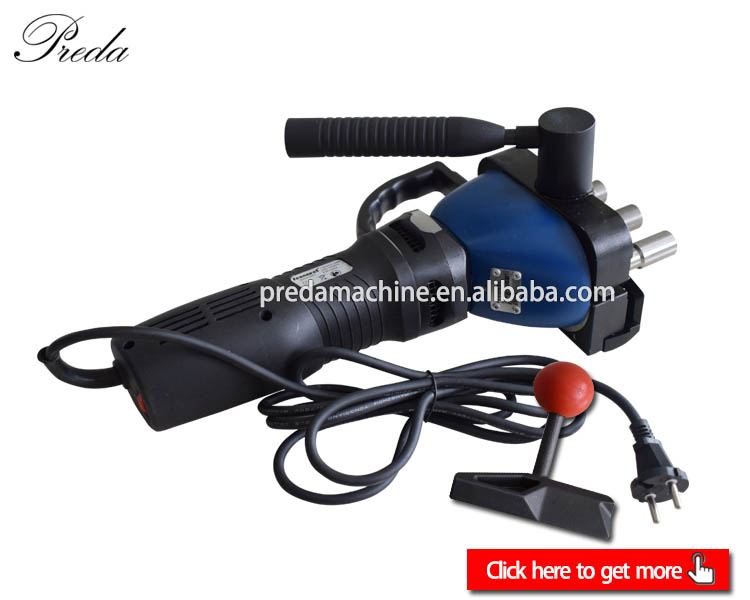
Portable Electric Seam Lockers
The portable electric closer is the tool for seams that cannot be brought to a bench: closures on installed duct, retrofits in existing buildings, and shops that only close a few seams a day. A unit like the L-12 weighs around 120 kg, draws 0.55 kW from a standard socket, handles 0.5-1.0 mm galvanized and walks along the seam at roughly 10 m/min. Because it needs no air supply, it works on any floor with power - which on a construction site is most floors. The carrying case protects it in transit and it is the only powered closer that travels with the install crew rather than the shop.
Vertical Hydraulic Seam Lockers
For volume production, the vertical hydraulic closer is a different category of machine. The HF-1550 handles material up to 1.5 mm and duct widths up to 1550 mm, and closes a full-length seam in ten to thirty seconds with uniform roller pressure along the entire run. Uniform pressure is the point: hand-closed seams vary, and variation is exactly what fails a pressure test on the first try. The PLC touchscreen stores settings so the same section geometry comes out identical every time - which is what lets a shop promise "passes the test first time" to a general contractor.
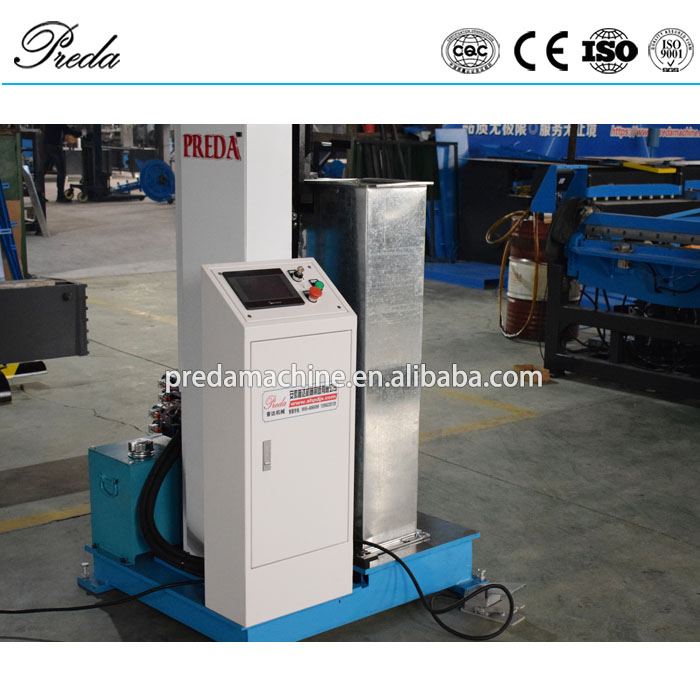
Electric vs Hydraulic: The Head-to-Head That Matters
For most buyers the real decision is portable electric versus vertical hydraulic, because these are the two machines a working shop actually owns. Pneumatic closers exist and have their niche, but on a bench the electric and hydraulic units dominate, and on site electric wins on simplicity. The comparison below uses the real specifications of the two machines discussed above.
| Specification | Portable electric (L-12 class) | Vertical hydraulic (HF-1550) |
|---|---|---|
| Material thickness | 0.5 - 1.0 mm | 0.5 - 1.5 mm |
| Max duct width | Section-limited (walk-along) | 1550 mm |
| Seam speed | About 10 m/min | 10 - 30 s per full-length seam |
| Power | 0.55 kW, standard socket | Hydraulic, PLC controlled |
| Weight | About 120 kg | Floor machine |
| Air supply needed | None | None |
| Best for | On-site closure, low-volume benches | Volume production, pressure-tested sections |
| Certification | CE | CE |
Electric vs Pneumatic: Where Air Comes In
Pneumatic seam closers run on compressed air, and that single fact decides their economics. If your shop already runs a compressor for other tools, an air-powered closer uses existing infrastructure; if not, the compressor becomes part of the machine's real cost - purchase, electricity, maintenance and the air loss that every pneumatic circuit leaks over time. The table below is a general industry comparison, because pneumatic units vary widely by make:
| Factor | Electric closer | Pneumatic closer |
|---|---|---|
| Air supply | None required | Compressor required |
| Portability | Any socket; travels to site | Tied to the air line |
| Noise | Motor only | Compressor noise in the circuit |
| Maintenance | Motor and rollers; simple | Air filters, lubricators, seals |
| Speed consistency | Constant under load | Drops as line pressure drops |
| Running cost | Electricity only | Electricity plus compressor upkeep |
| Typical home | Shops and install crews | Shops with heavy air infrastructure |
The question to ask yourself
Do not ask "which is better" - ask "where is the seam closed?" If the seam is on a bench in your shop and you pressure-test every section, the vertical hydraulic machine pays for itself in the test department. If the seam is on a roof or in a retrofit, the portable electric unit is the only one of the two that will actually be there.
What the Seam Close Actually Costs You
Putting real numbers on the operation makes the choice obvious. A crew closing seams by hand spends five to ten minutes per length, and the section has a real chance of failing the pressure test. The vertical hydraulic machine closes that length in ten to thirty seconds with repeatable pressure, so the section that leaves the machine is the section that passes. On a shop closing thirty seams a day, the difference is roughly two hours of bench time recovered - every day - plus the rework that never happens. On site, the portable electric unit does the same arithmetic in minutes per seam instead of hammering, and it is the tool that actually gets carried up the ladder.
Common Mistakes When Buying a Seam Locker
- Buying one machine for two jobs. A bench hydraulic unit does not go on site; a portable unit does not feed a production bench. Most shops end up with both.
- Ignoring the gauge range. Confirm the machine's thickness capacity against the material in your commercial quotes. 1.5 mm capacity covers residential and commercial alike.
- Forgetting pressure consistency. The value of a powered closer is not speed alone - it is that every seam comes off the same, which is what pressure tests reward.
- Assuming you need air. Check whether a compressor actually exists before choosing a pneumatic unit; many shops buy the compressor by accident.
- Skipping the running test. Request a video of the machine closing a seam at the factory before shipment.
Preda Care Service Promise
Every Preda Machine seam closer - portable electric and vertical hydraulic alike - ships CE certified with a two-year warranty, backed by 24/7 technical support, free spare parts shipping, remote PLC programming assistance and a global agent network. Machines installed since 2008 are still supported.
Need Help Choosing Your Seam Closer?
Tell us whether your seams close on the bench or on site, and the gauge you run - we will recommend the right unit with a factory video demo.
Compare Seam Closers →Frequently Asked Questions
Can an electric seam locker close heavy commercial duct?
Portable electric units typically handle 0.5-1.0 mm, which covers most residential and light commercial work. For 1.0-1.5 mm commercial sections, use a vertical hydraulic closer rated to that gauge.
Do I need an air compressor for a seam closer?
Only for pneumatic units. Electric and hydraulic closers need no air supply - which is why they are the default for shops without heavy air infrastructure and for on-site work.
How fast is seam closing on a machine?
A vertical hydraulic closer finishes a full-length Pittsburgh seam in ten to thirty seconds. A portable electric unit travels at about 10 m/min. Both replace five to ten minutes of hand hammering per length.
Will a seam locker make my sections pass pressure tests?
It removes the most common cause of failure: seams closed with uneven hand pressure. Uniform roller pressure along the full length means the section is consistent, which is the condition a pressure test is testing.