Ask ten duct shop owners what "duct forming machine" means and you will get ten different answers, because the term covers everything from a hand-fed Pittsburgh lockformer to a fully automatic coil-fed line. The machine that makes sense for a two-man shop is a waste of money for a shop quoting 3,000 square metres of duct a month, and the reverse is just as true. This guide breaks the family of duct forming equipment into the jobs each machine actually does, with the output numbers and the volume at which each type earns its keep.
Why the Forming Stage Decides Your Whole Shop
Rectangular duct production is a chain: cut the blank, form the edges, add beads and grooves, close the seams, then flange the ends. Most shops discover their bottleneck not at the shear but at the forming stage, because forming is where hand labour hides. A Pittsburgh seam closed by hammer takes five to ten minutes per length and depends on the swing of the operator. A beading job done on a slow machine queues up behind every other beading job. Getting the forming machine types right is the fastest way to raise output without adding a shift.
The Four Forming Jobs in a Rectangular Duct Shop
1. Lock forming: Pittsburgh and snap lock
The Pittsburgh lockformer rolls a female pocket on one edge of the blank and a male flange on the mating edge. Once both edges are formed, the sections slide together and the seam is closed. It is the workhorse of rectangular ductwork because it creates a strong, semi-permanent joint from a single sheet of galvanized steel. Snap lock machines do the same job for fittings and smaller work where the joint needs to be disassembled. Entry lockformers such as the SA-12HB class handle common gauges at a pace that suits a fabricator bench; heavier units extend the gauge range for commercial projects.
2. Seam closing
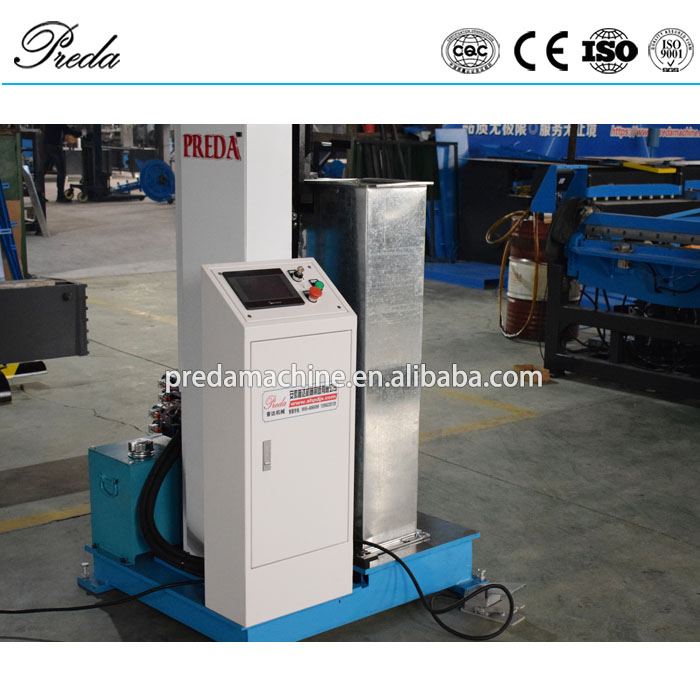
Forming the lock is only half the job. Closing it with consistent pressure is what makes the section airtight. Hand hammering takes five to ten minutes per length and produces seams that vary along the run - the usual reason a pressure test fails on the first attempt. A powered seam closer does the same length in ten to thirty seconds with uniform roller pressure. Vertical hydraulic units such as the HF-1550 handle duct widths up to 1550 mm in 0.5-1.5 mm galvanized and close both Pittsburgh and whisper-lock seams. Portable electric closers cover on-site work where the section cannot be moved to a bench.
3. Beading and grooving
Beads add stiffness to long panels so they do not drum and flex under static pressure; grooves create the receiving lines for TDF or TDC flanges. A dedicated duct beading machine or grooving machine does these jobs in one pass, and on a coil-fed line they are integrated into the same flow as cutting, so the blank arrives already beaded, notched and grooved.
4. Flanging and corner making
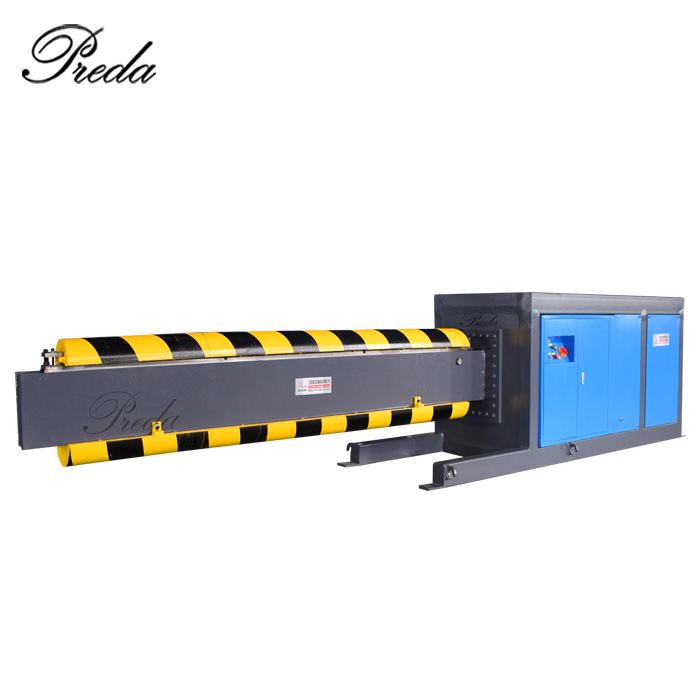
The flange turns a duct section into something that bolts to the next section. TDF flange formers fold the flange profile onto the duct end in one operation, and corner-making machines produce the corner pieces and cleats that complete the joint. For shops doing their own flanging, a dual-head former roughly doubles throughput over a single-head unit.
Round and Oval Duct Production
Round duct is a different family. A spiral tubeformer takes coil and forms a continuous helical lock seam, producing pipe in diameters from roughly 80 mm up to 1200 mm on the flexible models, at speeds of several metres per minute. A slitting head can trim the strip to produce different diameters without changing tooling. Flat oval duct, the standard answer for shallow ceiling voids, is produced by pressing round spiral duct through an ovalizer such as the PDTY-3000, which takes 100-800 mm input diameter in 0.5-1.2 mm gauge and forms the oval ratio the void demands. Oval keeps most of round's airflow efficiency while fitting a depth that round cannot.
Duct Forming Machine Types Compared
| Machine type | What it forms | Typical output / spec | Best suited to |
|---|---|---|---|
| Pittsburgh lockformer (SA-12HB class) | Pittsburgh lock edges on blanks | Bench-fed; gauge up to 1.2 mm on heavy models | Shops of any size; first machine most shops buy |
| Seam closer, portable electric | Closes Pittsburgh seams on-site | 0.5-1.0 mm, about 10 m/min, 0.55 kW, 120 kg | Install crews and low-volume benches |
| Seam closer, vertical hydraulic (HF-1550) | Closes Pittsburgh / whisper seams | 0.5-1.5 mm, duct width to 1550 mm, 10-30 s per seam | Volume shops that pressure-test every section |
| Duct beading / grooving machine | Stiffening beads, flange grooves | Single pass; 5 or 7 groove patterns | Any shop; integrated on auto lines |
| TDF flange former | Flange profile on duct ends | Single or dual head | Shops making their own bolted joints |
| Auto duct line (AML-3 class) | Leveling, beading, notching, shearing in one flow | 12 m/min, 0.45-1.5 mm, 2,000-5,000 m2/month | Shops that have outgrown separate machines |
| Spiral tubeformer | Round spiral duct from coil | Φ80-1200 mm on flexible models | Round duct producers |
| Ovalizer (PDTY-3000) | Flat oval from round duct | 100-800 mm input, 0.5-1.2 mm, adjustable ratio | Contractors working shallow voids |
Choosing by Volume: When Each Type Pays
Volume is the honest filter. The table below is a planning guide based on common shop profiles; the boundary moves with local labour cost, because the machine replaces labour first and material waste second.
| Monthly duct output | Sensible forming setup | Why |
|---|---|---|
| Under 1,000 m2 | Lockformer + portable seam closer + manual flange tools | Machines stay busy; an auto line would sit idle at 30% utilisation |
| 1,000 - 5,000 m2 | Lockformer + vertical hydraulic seam closer + beader; move to an AML-3 class line at the upper end | Seam closing becomes the bottleneck; a line removes the separate cutting and notching labour |
| Above 5,000 m2 | Full auto duct line (AML-5 class), dual-head flanger, dedicated ovalizer if you run oval | Labour per square metre drops sharply; scrap falls from 8-12% manual to 2-3% on the line |
Avoiding the classic mistake
An auto duct line running at low utilisation loses money against three semi-automatic machines running at 85%. Buy the forming machine that matches the volume you can keep it fed, and phase the upgrade path before you need it - not after the queue forms.
From Single Machines to an Automatic Line
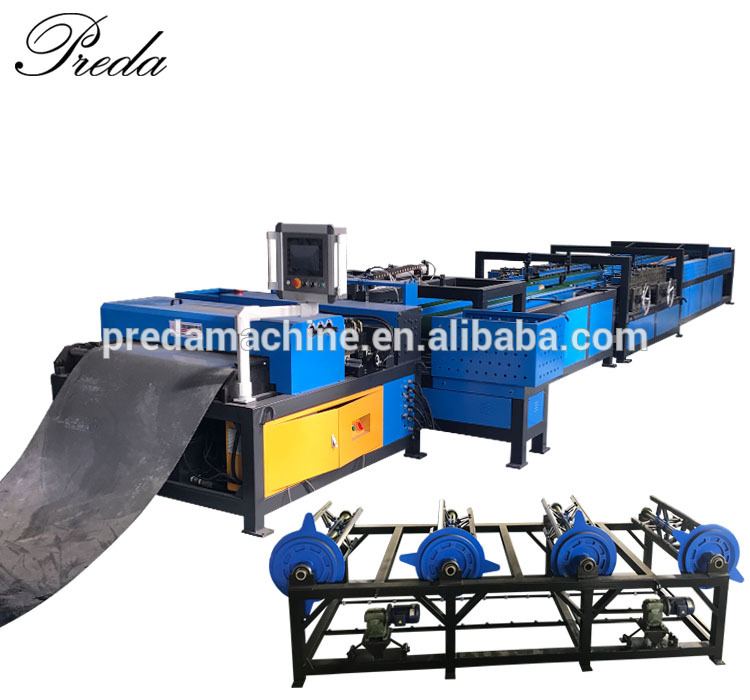
The step most shops underestimate is the jump from separate machines to a coil-fed line. On a manual workflow, four separate machines need four operators and the blanks move between stations, accumulating handling time and scrap. An auto duct line such as the AML-3 takes coil through decoiling, leveling, beading, notching and shear cutting in one pass, with a two-station coil car so the run does not stop for a coil change. The Mitsubishi PLC keeps geometry repeatable, which is what allows sections to fit without a fitter's persuasion. A line does not replace your lockformer and seam closer - it replaces the workflow feeding them.
Common Mistakes When Buying Duct Forming Equipment
- Buying a machine that outruns your labour. A fast former still needs someone feeding it; match speed to the people you can staff.
- Ignoring the gauge range. Check the machine's material thickness capacity against the commercial projects you actually quote, not the residential work you do today.
- Forgetting the seam closer. Shops spend on the lockformer and skip the closer, then hit the exact bottleneck that pressure tests expose.
- Underestimating scrap. Hand-cut workflows commonly scrap 8-12% of material; a line with programmed cutting holds waste to 2-3%.
- Skipping the factory test. Always ask for a running test video of the exact machine before shipment.
Preda Care Service Promise
Every duct forming machine from Preda Machine ships with CE certification and a two-year warranty, backed by 24/7 technical support, free spare parts shipping, remote PLC programming assistance and a global agent network. We have been supporting installed machines since 2008 - the machine is the start of the relationship, not the end.
Ready to Match the Machine to Your Volume?
Tell us your monthly duct area and the profiles you run - we will recommend the forming setup, with factory video demos of the exact machine.
View All Duct Forming Machines →Frequently Asked Questions
What is the difference between a Pittsburgh lockformer and a seam closer?
The lockformer forms the lock profile on the blank edges; the seam closer closes that formed seam after the sections are assembled. Most shops need both - the first shapes the metal, the second makes the joint airtight.
Can one machine do beading, grooving and cutting?
On an auto duct line, yes. Leveling, beading, notching and shear cutting run in the same PLC-controlled flow, so blanks arrive finished. As separate machines, each job is a separate pass.
What gauge range should a duct forming machine handle?
Residential HVAC work is mostly 0.5-0.8 mm galvanized; commercial and industrial projects commonly reach 1.0-1.5 mm. A machine rated to 1.5 mm covers both without a second unit.
Is an auto duct line worth it for a small shop?
Only above the volume that keeps it fed - roughly 2,000-5,000 m2 per month for an AML-3 class line. Below that, a lockformer, powered seam closer and beader run more economically.