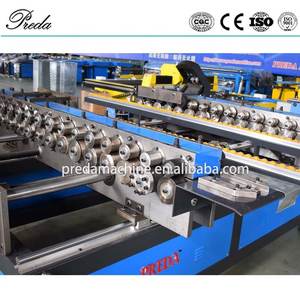
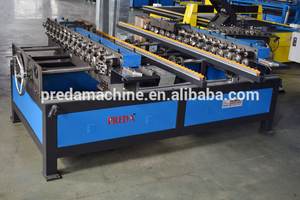


Duplex TDF Machine with Cleat
Last updated: October 12, 2026
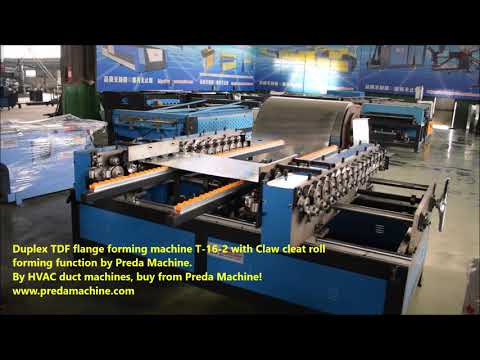
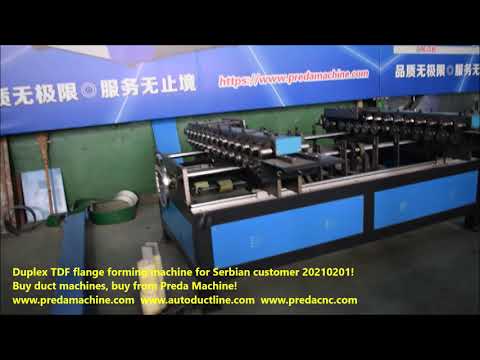
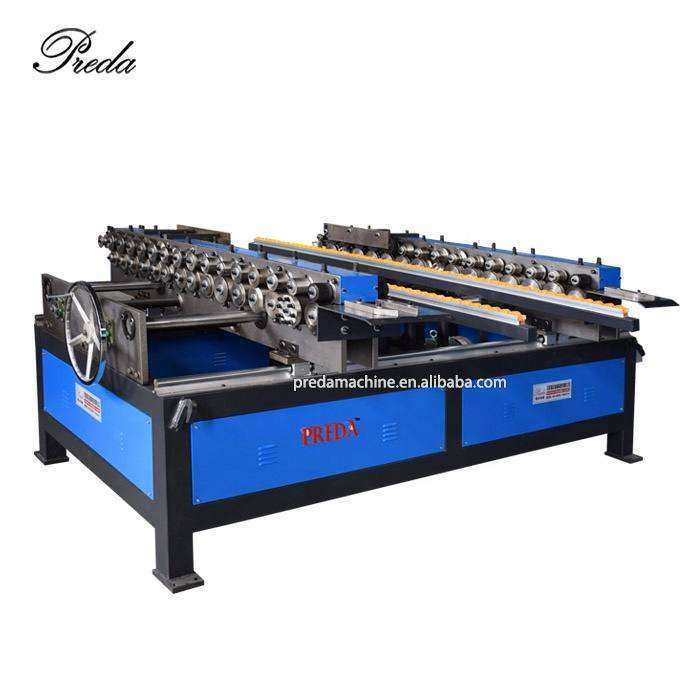
Duplex TDF flange former with integrated cleat notching for complete flange preparation.
Technical Specifications
What is a Duplex TDF Machine with Cleat?
A flange forming machine is sheet metal equipment that produces TDF (Transverse Duct Flange) or TDC (Transverse Duct Connector) flanges on the edges of rectangular duct panels. These flanges allow duct sections to be bolted together with gaskets for air-tight connections. Flange formers are typically used in conjunction with auto duct lines or as standalone machines for custom ductwork fabrication.
Key Features
- Combined flange forming and cleat cutting
- Reduces handling between machines
- CNC cleat positioning
- Consistent quality
Still Losing Money to Slow Flange Installation and Poor Seals?
Every HVAC duct shop faces the same bottleneck: manual flange forming and riveting. When your team spends hours on inconsistent flange dimensions, your production capacity drops, labor costs rise, and deadlines slip. The Duplex TDF Machine with Cleat is engineered to eliminate these inefficiencies — automating duplex TDF with cleat while delivering consistent, factory-grade quality.
In this guide, we break down exactly how this machine transforms your TDF flange cleat notching workflow, what specifications matter for your operation, and how to calculate your return on investment. Whether you run a 3-person job shop or a 50-employee production facility, understanding these details directly impacts your bottom line.
How It Transforms Your Production Line
The Duplex TDF Machine with Cleat operates on a proven principle: duplex TDF with cleat should be a continuous, automated process — not a series of manual interventions. Here is the step-by-step workflow that makes this possible:
Panel Feeding
The duct panel edge is fed into the flange forming rollers, with adjustable guides ensuring proper alignment.
Flange Roll Forming
Multiple roller stations progressively form the TDF/TDC flange profile — creating the integral flange that replaces traditional angle iron frames.
Corner Notching (Optional)
Integrated notching stations cut the corner reliefs needed for clean 90° flange corners.
Corner Crimping
Hydraulic or pneumatic corner tools crimp the flange corners, creating a rigid, square connection point.
Technical Specifications & Performance Data
Every specification on this machine is chosen for a reason. The table below shows not just the numbers, but what each one means for your daily production:
| Parameter | This Machine | What It Means for You |
|---|---|---|
| Control System | PLC with touchscreen | Easy programming, consistent results, minimal training |
| Construction | Heavy-duty steel frame | Vibration-free operation, 10+ year service life |
| Certification | CE certified | Meets European safety and quality standards |
| Warranty | 2 years | Peace of mind with comprehensive factory warranty |
Problems Solved: Before vs. After
We asked 50+ HVAC fabricators about their biggest production headaches. Here is how this machine directly addresses each one:
| Without This Machine | With This Machine |
|---|---|
|
✕ Angle iron flanges are heavy and slow
Welding angle iron takes 10-15 min per duct, adds weight |
✓ TDF integral flange formed in seconds
Flange time reduced to 30 seconds, 40% lighter |
|
✕ Flanges don't align on site
Gaps between flanges cause air leakage, need shimming |
✓ CNC-formed flanges with ±0.3mm accuracy
Perfect flange alignment, gasket seals every time |
|
✕ Riveting is slow and labor-intensive
Each flange needs 8-12 rivets, 5-10 minutes per duct |
✓ TDF flange is integral — no rivets needed
Eliminate riveting entirely, save 70% assembly time |
|
✕ Corner gaps and leaks
Poor corner construction is the #1 leak source |
✓ Hydraulic corner crimping creates tight corners
Leakage class C compliance, no corner leaks |
Where It Fits in Your Factory
This machine is versatile enough to serve multiple production scenarios. Here are the most common configurations our customers use:
Commercial HVAC Ductwork
TDF flanges are the global standard for commercial rectangular duct connections — used in offices, hospitals, schools, and retail.
Industrial Ventilation
TDC flanges for high-pressure industrial systems where heavier gauge and stronger connections are required.
Duct Retrofit & Replacement
Upgrading old angle-iron duct systems to modern TDF flange technology for better sealing and faster installation.
Prefabrication Facilities
High-volume duct prefab shops where consistent flange quality is essential for just-in-time delivery to construction sites.
Frequently Asked Questions
Click each question to see the answer. These are the questions our sales engineers hear most often:
Duplex TDF With Cleat: When One Machine Beats Two Stations
This machine forms both panel edges and prepares the cleat in the same handling. It costs more than a plain duplex former and less than a former plus a separate corner bench plus the labour to move panels between them. The break-even is roughly two operators' worth of handling time per shift.
| Setup | Stations | Handling | Best fit |
|---|---|---|---|
Duplex TDF with Cleat This machine — flange and cleat in one handling | One machine, one pass No separate corner bench | Panel handled once Largest saving is handling, not forming | Shops where corner preparation is a visible bottleneck Or where floor space is too tight for two stations |
Flange only, both edges | One machine plus a corner bench Two handlings | Panel moved to a separate station for corners More floor space | Corner work is already fast or done in batches Cheaper entry into duplex forming |
Corner station only | Pairs with any flange former Adds a station | Flexible — can serve more than one former Lower capital | You want the corner station to serve several lines More flexible than integrating cleat forming |
TDC profile | As specified Different profile | For TDC work Not interchangeable | Your specification calls for TDC Different system entirely |
Single head, heavy gauge | One machine plus corner bench Two passes per panel | Manual panel turning Lowest capital | Gauge is the constraint and volume is moderate Simplest machine to keep running |
Integrating Cleat Forming Without Slowing the Flange Pass
Adding an operation to a pass only pays if the pass does not get longer. These steps protect the throughput you bought the machine for.
- 1. You need a baseline. If the cleat operation adds more than about 20% to the cycle, the setting is wrong rather than the machine.
- 2. Cleat depth is measured from the flange face, not from the panel edge. Setting it by eye will produce cleats that look right and do not engage.
- 3. A cleat that is 0.5 mm shallow will not hold under assembly force. Dry-fit one corner per batch rather than discovering it on site.
- 4. The cleat station is positioned relative to the panel edge. Mixed widths mean resetting two stations instead of one.
- 5. Cleat punches and dies wear faster than forming rolls because they shear rather than form. A dull cleat tool tears instead of cutting and the burr prevents engagement.
- 6. The cleat station is the only part of the machine where an operator's hand naturally goes near a moving tool. Make the stop rule explicit.
- 7. Separate flange defects from cleat defects. The split tells you which station to invest in, and it usually is not the one people assume.
- 8. It is the fastest-wearing item on the machine and the one most likely to stop production while you wait for a shipment.
Integrated Cleat Faults: Symptom, Cause, Fix
With two operations in one machine, the first diagnostic step is always to decide which station produced the defect. Everything else follows from that.
| Symptom | Most likely cause | What to do |
|---|---|---|
Flange correct, cleat shallow Cleat depth set from the wrong datum | Depth measured from the panel edge rather than the flange face The most common set-up error on this machine | Re-set the cleat depth from the flange face and test on scrap Record the datum on the set-up card |
Cleat torn rather than cut Cleat tooling dull or clearance excessive | Cleat tools shear rather than form, so they wear far faster than rolls Shows as a ragged edge and a burr | Replace or regrind the cleat punch and die and check the clearance Keep a spare set in store — this is the fastest-wearing item |
Cleat position drifts along the batch Panel stop or gauge inconsistent | The cleat is positioned from a stop; a worn or loose stop moves it Often blamed on the tooling | Check the stop for wear and tighten it, then re-verify position on three panels Add the stop to the weekly inspection list |
Both flange and cleat out of tolerance Panel width variation | Both stations reference the panel edge, so a width error appears in both A shared cause, which is the useful clue | Measure panel width at the start of the batch Batch by width rather than by job number |
Cycle time longer than expected Cleat station set to dwell unnecessarily | The cleat operation is set for a slower cycle than it needs A setting issue, not a capability limit | Reduce the dwell to the minimum that produces a clean cleat Time ten cycles before and after so you know the real saving |
Corner will not close on assembly Cleat height, not cleat depth | A cleat can be the correct depth and still hold the corner open if its height is wrong Frequently misdiagnosed as a forming fault | Measure cleat height on a sample and compare with the corner piece specification If in doubt, send us the sample — it is faster than guessing |
Professional Packaging & Global Shipping
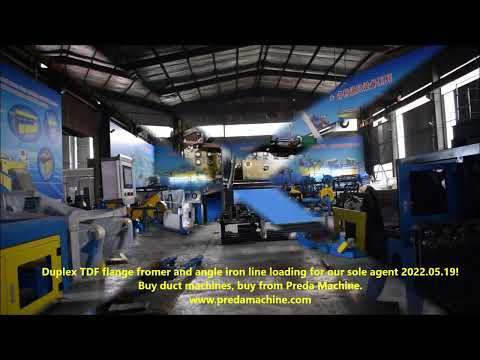
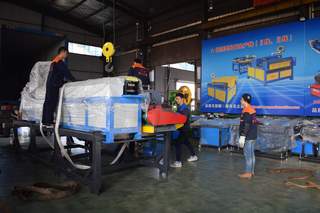
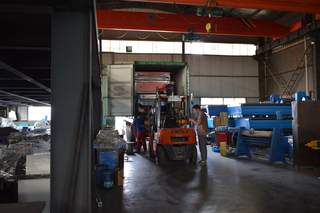
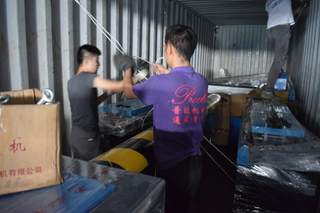
Every machine is professionally packaged and secured in a container for safe delivery to your port. We send you loading photos before the ship sails.
Calculate Your Return on Investment
Based on average industry data, here is what a typical customer saves after installing this machine:
* Figures based on average customer data for a shop producing 300-800 duct sections per month. Your actual results will vary based on production volume, labor rates, and current efficiency levels. Contact our engineers for a customized ROI calculation based on your specific operation.
Ready to Upgrade Your Duplex Production?
Get a customized quote within 24 hours. Our engineers will help you configure the right machine for your specific production requirements.
WhatsApp / WeChat: +86-18355321923 | Email: jason@predamachine.com
Related Products


Buying Guides for This Machine Type
Before you request a quote: how this machine class compares, what it costs, and how to size it for your production volume.
TDF vs TDC Flange Guide
The two dominant rectangular duct flange systems compared on sealing, speed and installed cost.
Read the guide → Buying GuideTDF Corner Making Guide 2026
Corner machine vs corner matics vs hand molds: the real cost per corner at different volumes.
Read the guide → Buying GuideTDF Flange Former Buying Guide 2026
T-12 vs T-16 vs Duplex vs Dual Head — throughput, gauge range and shop-size fit.
Read the guide → ComparisonTDF Bender: Electric vs Pneumatic
Power source choice for TDF benders — air supply requirements, cycle speed and maintenance load.
Read the guide →