
Spiral Duct Flanger
Last updated: October 12, 2026
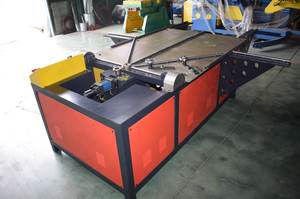
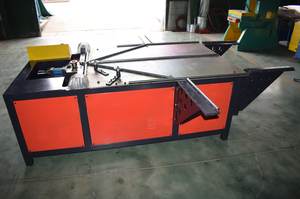
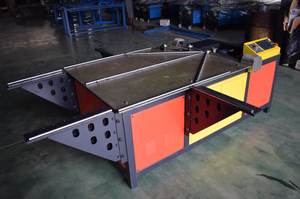
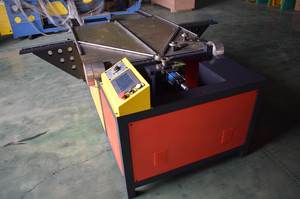
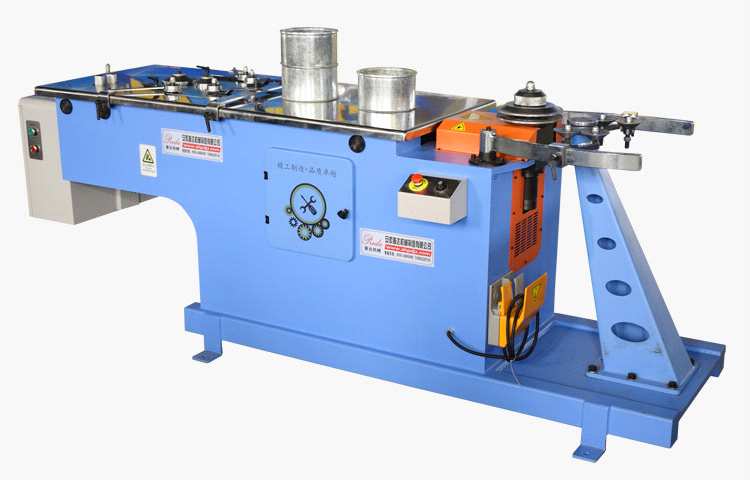
Patented machine forms flanges on spiral duct ends from 8" to 48" diameter, up to 18 gauge.
Technical Specifications
What is a Spiral Duct Flanger?
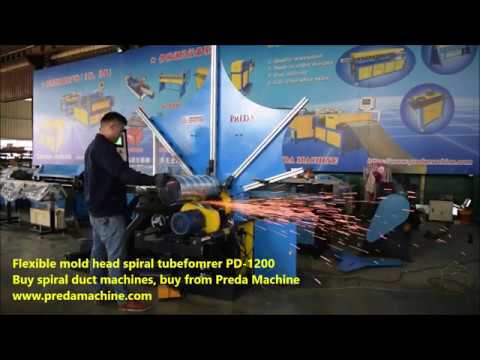
A spiral duct forming machine (also called a spiral tubeformer) is an industrial machine that continuously manufactures round spiral ducts from galvanized steel, stainless steel, or aluminum coils. The machine forms a helical seam by rotating metal strip around a fixed mandrel, producing ducts with superior structural rigidity and air-tightness compared to rectangular ducts. Spiral duct machines are widely used in HVAC ventilation, dust collection, and exhaust systems.
Key Features
- Eliminates manual Vanstone connections
- Consistent flange quality
- Fast setup and operation
- Heavy-duty construction
Still Losing Money to Inconsistent Spiral Duct Quality?
Every HVAC duct shop faces the same bottleneck: manual spiral duct forming. When your team spends hours on hand-forming seams and cutting lengths, your production capacity drops, labor costs rise, and deadlines slip. The Spiral Duct Flanger is engineered to eliminate these inefficiencies — automating spiral duct flanger while delivering consistent, factory-grade quality.
In this guide, we break down exactly how this machine transforms your vanstone flange machine workflow, what specifications matter for your operation, and how to calculate your return on investment. Whether you run a 3-person job shop or a 50-employee production facility, understanding these details directly impacts your bottom line.
How It Transforms Your Production Line
The Spiral Duct Flanger operates on a proven principle: spiral duct flanger should be a continuous, automated process — not a series of manual interventions. Here is the step-by-step workflow that makes this possible:
Coil Feeding & Leveling
Galvanized steel or aluminum coil is automatically fed through precision leveling rollers, eliminating coil memory and ensuring a perfectly flat strip enters the forming head.
Continuous Spiral Forming
The strip is wrapped around the forming mandrel while the lock seam is simultaneously rolled and crimped. This creates the characteristic spiral seam that gives round ducts their superior strength and airtightness.
Precision Length Cutting
A flying shear or slitter cuts the continuous tube to your exact programmed length without stopping production — critical for maintaining high output rates.
Automatic Discharge
Finished ducts are automatically ejected onto the collection table, ready for flange installation or direct shipment.
Technical Specifications & Performance Data
Every specification on this machine is chosen for a reason. The table below shows not just the numbers, but what each one means for your daily production:
| Parameter | This Machine | What It Means for You |
|---|---|---|
| Control System | PLC with touchscreen | Easy programming, consistent results, minimal training |
| Construction | Heavy-duty steel frame | Vibration-free operation, 10+ year service life |
| Certification | CE certified | Meets European safety and quality standards |
| Warranty | 2 years | Peace of mind with comprehensive factory warranty |
Problems Solved: Before vs. After
We asked 50+ HVAC fabricators about their biggest production headaches. Here is how this machine directly addresses each one:
| Without This Machine | With This Machine |
|---|---|
|
✕ Inconsistent duct diameter
Ducts don't fit together on site, causing rework and delays |
✓ PLC-controlled diameter accuracy ±0.5mm
Every duct fits perfectly on first try, zero rework |
|
✕ Slow manual production
2-3 workers needed per machine, max 5-8 ducts/hour |
✓ Automated continuous production up to 38 m/min
One operator produces 30-60 ducts/hour |
|
✕ Air leakage at seams
Energy loss, failed pressure tests, customer complaints |
✓ Precision spiral lock seam with 360° crimping
Leakage class C/D compliance, passes every pressure test |
|
✕ Material waste from bad cuts
10-15% scrap rate from manual cutting errors |
✓ CNC flying shear with ±1mm length accuracy
Scrap rate below 2%, significant material savings |
Where It Fits in Your Factory
This machine is versatile enough to serve multiple production scenarios. Here are the most common configurations our customers use:
Commercial HVAC Projects
Shopping malls, office towers, hospitals — anywhere large volumes of round duct are needed for main supply and exhaust runs.
Industrial Ventilation
Factory exhaust systems, dust collection, fume extraction where durable, airtight round duct is essential.
Tunnel & Underground
Metro stations, parking garages, underground facilities requiring high-pressure, large-diameter ductwork.
Duct Fabrication Shops
Sheet metal shops producing spiral duct for contractors — the core revenue machine for round duct specialists.
Frequently Asked Questions
Click each question to see the answer. These are the questions our sales engineers hear most often:
Spiral Duct Flanger: End Finishing Options Compared
A flanger forms a flange on the end of a spiral tube so it can be bolted to the next section. It is a finishing machine, and it is often bought as an afterthought — then becomes the bottleneck because nobody sized it. Match its throughput to your tubeformer, not to your average order.
| Method | Joint type | Speed | Choose it when |
|---|---|---|---|
Spiral Duct Flanger This machine — formed end flange | Bolted flanged joint Strong and reusable | One tube end at a time Operator-paced | Your specification calls for bolted flanged joints Common on industrial and larger-diameter work |
Closes the longitudinal seam | N/A — a different operation The tube itself | Continuous Upstream | You need the seam closed rather than the end flanged Not a substitute — both are needed on a welded-tube line |
Makes separate rings | Ring flanges fitted to the tube Two-part assembly | Continuous from strip Different output | You want separate rings rather than a formed end flange Different product, often used on larger diameters |
Makes the tube | N/A Upstream | Continuous The source of the tube | You need the tubeformer as well Size the flanger to match this machine's output |
Makes the fittings | N/A Fittings, not straight tube | Per fitting Complementary | You want to make elbows as well as flanged tube ends Part of completing a round duct line |
Setting Up a Flanger So It Keeps Up With the Tubeformer
A flanger that cannot match the tubeformer's output will silently become the constraint on the whole round duct line. Size and set it deliberately.
- 1. Most tubes need two flanged ends. Size the flanger on ends per hour, and compare that with the tubeformer's metre output converted to tubes.
- 2. Flange tooling is diameter-specific. If you run five diameters, you need the tooling for five diameters staged at the machine.
- 3. Set by dry-fitting an actual mating flange rather than by measurement alone. A flange that measures right can still not bolt up.
- 4. Hole alignment is the fault that reaches site. Verify it on the first piece of every diameter, every time.
- 5. A tube that is not supported will produce a flange that is out of square with the tube axis, which will not bolt up.
- 6. On a machine with diameter-specific tooling, walking to a store is the hidden cost.
- 7. This is the number that tells you whether the flanger or the tubeformer is the real constraint.
- 8. Over-forming fractures the galvanising at the bend, and that is where corrosion starts. If you see zinc cracking, reduce the forming depth.
Flanger Faults: Symptom, Cause, Fix
Flange faults that survive to site are expensive, so verify on a mating flange at the machine rather than trusting a measurement.
| Symptom | Most likely cause | What to do |
|---|---|---|
Flange will not bolt up Hole pattern misaligned or flange out of square | Either the hole pattern is wrong or the tube was not supported during forming The fault that causes the most expensive rework | Dry-fit a mating flange at the machine and check bolt holes before dispatch Support the tube for every flange |
Flange depth inconsistent Tooling not seated or the setting has drifted | Diameter-specific tooling that is not fully seated Common after a tooling change | Re-seat the tooling and set depth from a test piece, then dry-fit a mating flange Check at the start of every diameter |
Galvanising cracks at the bend Forming depth too great | Over-forming fractures the coating, which is where corrosion starts Looks like a strong flange and fails early in service | Reduce the forming depth to the minimum that produces a bolt-ready flange Record the setting per gauge |
Flange out of square with the tube Tube not supported during forming | A handling issue rather than a machine setting Very common on larger diameters | Support the tube on a stand for every flange and check squareness on the first piece Do not flange a tube held in the air |
Flanger cannot keep up with the tubeformer Undersized for the line | The flanger was bought to the average order, not to the tubeformer's peak output A sizing mistake that shows up months later | Measure ends per hour against tubeformer output for two weeks If the gap is large, a second flanger is cheaper than the bottleneck |
Tooling wearing quickly Material harder or thicker than specified | Stainless and heavy-gauge stock accelerate tooling wear sharply Often a purchasing change rather than a fault | Confirm the material specification and keep a spare tooling set for hard materials Stock tooling by diameter if stainless is routine |
Professional Packaging & Global Shipping
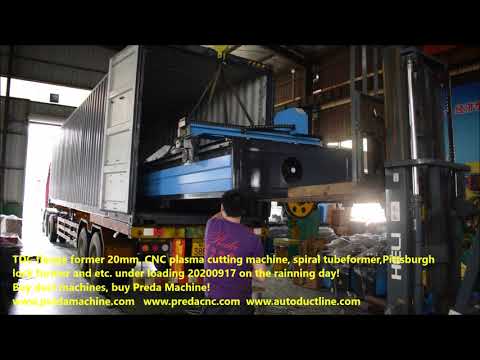
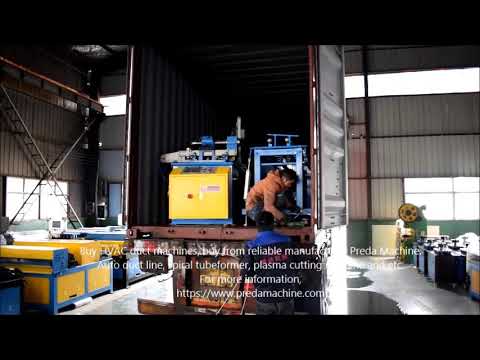
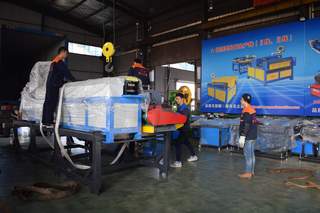
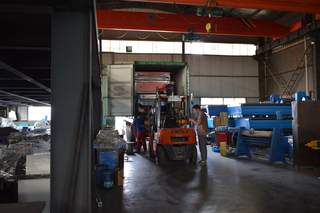
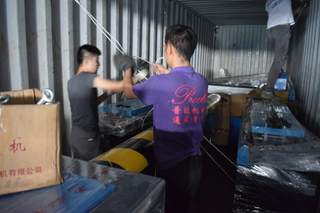
Every machine is professionally packaged and secured in a container for safe delivery to your port. We send you loading photos before the ship sails.
Calculate Your Return on Investment
Based on average industry data, here is what a typical customer saves after installing this machine:
* Figures based on average customer data for a shop producing 500-1000m² of duct per month. Your actual results will vary based on production volume, labor rates, and current efficiency levels. Contact our engineers for a customized ROI calculation based on your specific operation.
Ready to Upgrade Your Spiral Production?
Get a customized quote within 24 hours. Our engineers will help you configure the right machine for your specific production requirements.
WhatsApp / WeChat: +86-18355321923 | Email: jason@predamachine.com
Related Products
Buying Guides for This Machine Type
Before you request a quote: how this machine class compares, what it costs, and how to size it for your production volume.
Round Flange Forming Guide
Angle ring flange production from coil: roll forming, welding and bolt-hole layout.
Read the guide → Buying GuideSpiral Duct Machine Buying Guide
How to match tubeformer diameter range, gauge capacity and mould type to your actual order mix.
Read the guide → ComparisonSpiral vs Rectangular Duct
Which profile wins on material cost, pressure drop and installation labour — with decision rules.
Read the guide → ProcessOval Duct Manufacturing Guide
How flat oval duct is formed from round spiral tube, and when oval beats rectangular.
Read the guide →