This guide covers everything you need to know about Oval Duct Manufacturing. Key takeaways: detailed specifications, cost comparisons, pros and cons, maintenance requirements, and expert recommendations from Preda Machine — a leading HVAC duct machinery manufacturer since 2008, serving 60+ countries.
In This Guide
What is Flat Oval Duct?
Flat oval duct (also called oval duct or elliptical duct) is manufactured by first producing a round spiral duct, then compressing it into an oval shape using a specialized ovalizer machine. The result is a duct with two flat sides and two rounded ends, maintaining the spiral seam integrity of round duct while fitting into tight ceiling spaces.
🎬 Watch Related Product Videos
See our machines running in real factory tests
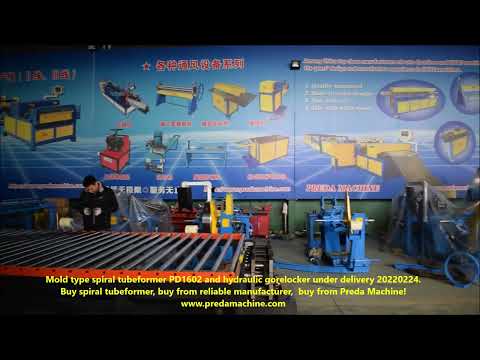
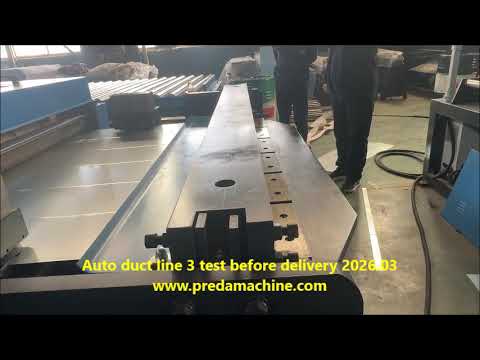

Oval duct is widely used in commercial buildings with limited plenum space — offices, hospitals, universities, and retail centers where rectangular duct would be too deep but round duct won't fit the available height.
Advantages of Oval Duct
| Advantage | vs Rectangular | vs Round |
|---|---|---|
| Space efficiency | Better (lower profile) | Better (fits tight spaces) |
| Aerodynamics | Better (lower friction) | Slightly worse |
| Leakage rate | Better (spiral seam) | Equal |
| Material usage | Less (no corners) | Equal |
| Noise level | Lower | Equal |
| Installation speed | Faster | Equal |
| Cost per meter | 10-15% less | 5-10% more |
Key Benefit
Oval duct offers 80% of round duct's aerodynamic advantage while fitting into 50% less vertical space. For buildings with 200-300mm plenum height, oval duct is often the only viable option for high airflow.
Manufacturing Process
Oval duct production is a two-step process:
- Step 1: Produce round spiral duct — Use a spiral duct machine (like the Preda PD1600) to produce round spiral duct to the required length and diameter. The round duct diameter determines the oval duct's width.
- Step 2: Ovalize the duct — Feed the round duct into an ovalizer machine, which uses two hydraulic presses to compress the round duct into a flat oval shape. The compression ratio is adjustable to achieve the desired height.
The ovalizer uses contoured forming shoes that match the desired oval profile. The duct is compressed gradually to avoid wrinkling or deforming the spiral seam. Typical cycle time is 30-60 seconds per duct section.
Standard Flat Oval Duct Dimensions
| Round Diameter | Oval Width (A) | Oval Height (B) | Equivalent Area |
|---|---|---|---|
| 100mm | 150mm | 75mm | 0.008 m² |
| 150mm | 220mm | 110mm | 0.018 m² |
| 200mm | 300mm | 150mm | 0.031 m² |
| 250mm | 370mm | 185mm | 0.049 m² |
| 315mm | 460mm | 230mm | 0.078 m² |
| 400mm | 590mm | 295mm | 0.126 m² |
| 500mm | 740mm | 370mm | 0.196 m² |
| 630mm | 930mm | 465mm | 0.312 m² |
Note: Standard oval ratio is 2:1 (width = 2 × height). Custom ratios are available but require special forming shoes. The equivalent area is approximately 78.5% of the original round duct area.
Equipment Needed
| Equipment | Function | Price Range | Required? |
|---|---|---|---|
| Spiral duct machine | Produce round spiral duct | $8,000-$25,000 | Essential |
| Ovalizer machine | Compress round to oval | $5,000-$12,000 | Essential |
| Cutting saw | Cut duct to length | $1,000-$3,000 | Recommended |
| Oval fittings kit | Elbows, tees, reducers | $2,000-$5,000 | Optional |
Preda Machine offers a complete oval duct production package: PD1600 spiral tubeformer + ovalizer machine + cutting saw. The ovalizer handles duct diameters from 100-800mm with adjustable compression ratio.
Cost Comparison
| Duct Type | Material Cost (per m) | Labor Cost (per m) | Total (per m) |
|---|---|---|---|
| Rectangular (TDF) | $12-$18 | $8-$12 | $20-$30 |
| Round spiral | $8-$14 | $4-$8 | $12-$22 |
| Flat oval | $9-$15 | $5-$9 | $14-$24 |
Oval duct costs approximately 10-15% more than round spiral (due to the ovalizing step) but 15-25% less than rectangular TDF duct. For projects with space constraints, oval duct offers the best balance of performance and cost.
Frequently Asked Questions
Preda Care: After-Sales That Never Expires
When you invest in HVAC duct manufacturing equipment, downtime costs money. With Preda Care, you get lifetime technical support — not just during warranty, but for the entire life of your machine. Our global agent network provides local service in 40+ countries.
- 24-hour response time
- Free spare parts shipping
- Remote PLC program support
- Global agent network
- Video call troubleshooting
- On-site installation
Flat Oval Dimensions and Standard Sizes
Flat oval duct is specified by its major axis (width) and minor axis (height), not by diameter. The equivalent round diameter is the diameter of a round duct with the same cross-sectional area and the same airflow capacity.
Equivalent diameter ≈ 1.55 × A0.625 × P0.25, where A is cross-sectional area and P is perimeter — but in practice most shops work from a standard size table.
| Standard size (mm) | Area (m²) | Equivalent round Ø | Typical application |
|---|---|---|---|
| 75 × 25 | 0.0029 | 60 mm | Residential branch |
| 100 × 50 | 0.0055 | 85 mm | Residential and hotel risers |
| 150 × 75 | 0.0118 | 125 mm | Shallow ceiling voids |
| 200 × 100 | 0.0201 | 165 mm | Corridor runs above dropped ceilings |
| 300 × 150 | 0.0408 | 235 mm | Commercial main runs in limited height |
| 400 × 200 | 0.0691 | 305 mm | Plant room distribution |
| 600 × 250 | 0.1237 | 410 mm | Large commercial mains |
Aspect Ratio Limit
Keep the major-to-minor axis ratio below about 4:1. Beyond that the duct loses stiffness, oil-cans under negative pressure, and becomes noisy. If you need more area in the same height, run two ducts side by side.
Forming Process: From Spiral Tube to Flat Oval
There are two routes to a flat oval duct, and they suit different volumes.
Route 1 — Form from Spiral Tube (high volume)
- Produce round spiral tube at the calculated equivalent circumference.
- Pass the tube through a flat oval forming machine with a pair of opposed rolls and a width stop.
- The rolls progressively deform the round section into the oval; the spiral lock seam stays intact and runs along one flat face or the curved edge depending on orientation.
- Cut to length. Typical cycle is 20–40 seconds per 3 m length.
Route 2 — Two-Piece Locked (low volume / large sizes)
- Roll two half-shells on a roller or brake.
- Form Pittsburgh locks on both long edges.
- Assemble and close the locks with a seam locker.
- Fit end caps or flanges.
| Factor | Route 1 (from spiral) | Route 2 (two-piece) |
|---|---|---|
| Setup time | 10 – 20 min | 5 min |
| Cycle time per 3 m | 20 – 40 s | 6 – 12 min |
| Minimum economic batch | 30 lengths | 1 length |
| Seam integrity | Continuous spiral lock | Two longitudinal locks |
| Size flexibility | Limited by roll set | Any size |
Gauge and Pressure Class for Flat Oval
Flat oval duct carries pressure differently from round duct: the flat faces deflect under pressure while the curved ends resist it. That means the gauge must be selected as if the duct were a rectangular duct of the same major dimension, not as a round duct of equivalent diameter.
| Major axis | Up to 500 Pa | 500 – 1000 Pa | 1000 – 1500 Pa | Reinforcement |
|---|---|---|---|---|
| Up to 200 mm | 0.6 mm | 0.6 mm | 0.8 mm | None required |
| 200 – 400 mm | 0.6 mm | 0.8 mm | 1.0 mm + bead | Bead or cross-break above 1000 Pa |
| 400 – 600 mm | 0.8 mm | 1.0 mm + bead | 1.2 mm + bead | Bead every 600 mm |
| 600 – 900 mm | 1.0 mm | 1.2 mm + bead | 1.2 mm + tie rod | Bead plus internal tie above 1200 Pa |
Cross-breaking with a beading machine is cheap insurance. On a 600 mm flat face at 750 Pa, a single cross-break reduces visible panel movement from about 8 mm to under 1 mm, and removes the "booming" noise that prompts complaints after handover.
Need Equipment Recommendations?
Tell us your duct specifications, daily production volume, and workshop size — our engineers recommend the perfect equipment configuration within 24 hours.
Get Free ConsultationContinue Reading: Related Guides
Go deeper on this topic, then compare the machines that do the work.
Spiral Duct Machine Buying Guide
How to match tubeformer diameter range, gauge capacity and mould type to your actual order mix.
Read the guide → ComparisonSpiral Tubeformer Buying Guide 2026
Head-to-head comparison of PD1600, PD1200 and PD2000 — capacity, price band and ideal shop size.
Read the guide → ReferenceRound Duct Fittings Guide
Elbows, tees, reducers and takeoffs: the fittings you need and the machines that make them.
Read the guide → Buying GuideRound Flange Production Guide 2026
Forming line vs angle iron bender vs welder — three routes compared on cost and throughput.
Read the guide →Machines covered in this topic
Compare specifications, gauge range and output for the machines discussed above.
Heavy Duty Spiral Tubeformer PD-2000
Φ200–2000 mm heavy-gauge spiral tube production
View specs → MachinePlasma Cut Spiral Tubeformer PD1600-PLASMA
Spiral tubeformer with integrated plasma cutting
View specs → MachineHydraulic Elbow Making Machine
Hydraulic gorelocker for elbow segment production
View specs → MachineRound Flange Forming Line YFL-40
Automatic angle ring flange forming line
View specs →