A spiral tubeformer turns narrow strip into a continuous helical tube, and a cutoff station divides that tube into the lengths a project list calls for. The method doing the dividing matters: a roller shear cuts the strip material mechanically, while a plasma station melts through the tube with an arc. Shops choosing between them weigh cut edge, gauge and diameter range, whether the tube must stop to be cut, and how the cutoff setup pairs with the forming head. This guide compares the two cutoff methods and pairs them with the PD-1600 and PD-2000 spiral tubeformer specifications listed on the Preda product pages, without treating one method as right for every duct size.
How a Spiral Tube Reaches the Cutoff Station
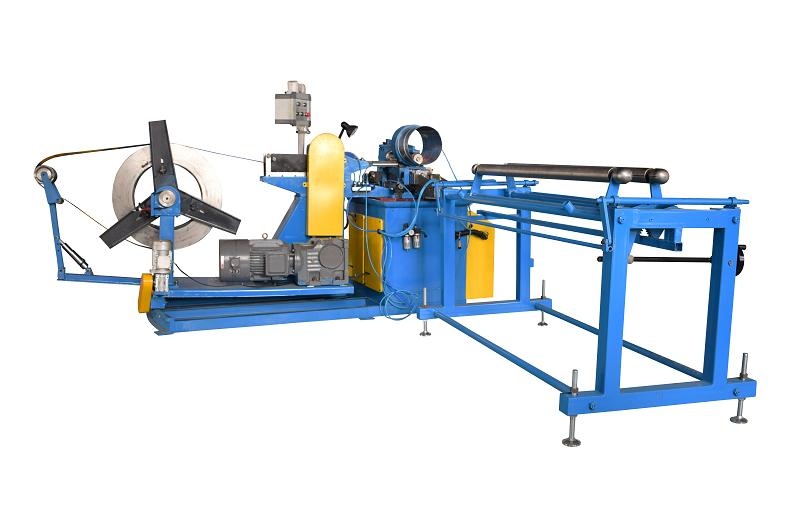
Spiral duct begins as narrow strip fed from the coiler into the forming head, where rollers roll the strip into a helix and close the spiral seam along the outside of the growing tube. The tube advances axially as the helix turns, so the cutoff station sits after the forming head and measures tube length against the programmed section size. Whether that station cuts by shear or arc, its job is the same: separate the continuous tube at the target length with an edge the downstream fitting, flange or end cap can still seat against.
Cutoff quality feeds straight into downstream work. A rough or deformed edge makes the next spiral joint, gasket or flange fit less cleanly and can leave a burr that has to be dressed by hand. Because the tube is round and rotating against the seam, the cutoff method also has to track the tube's advance; a stop-and-cut arrangement holds the tube still, while an on-the-fly station moves with the tube for the moment of the cut.
Roller Shear / Mechanical Cutting
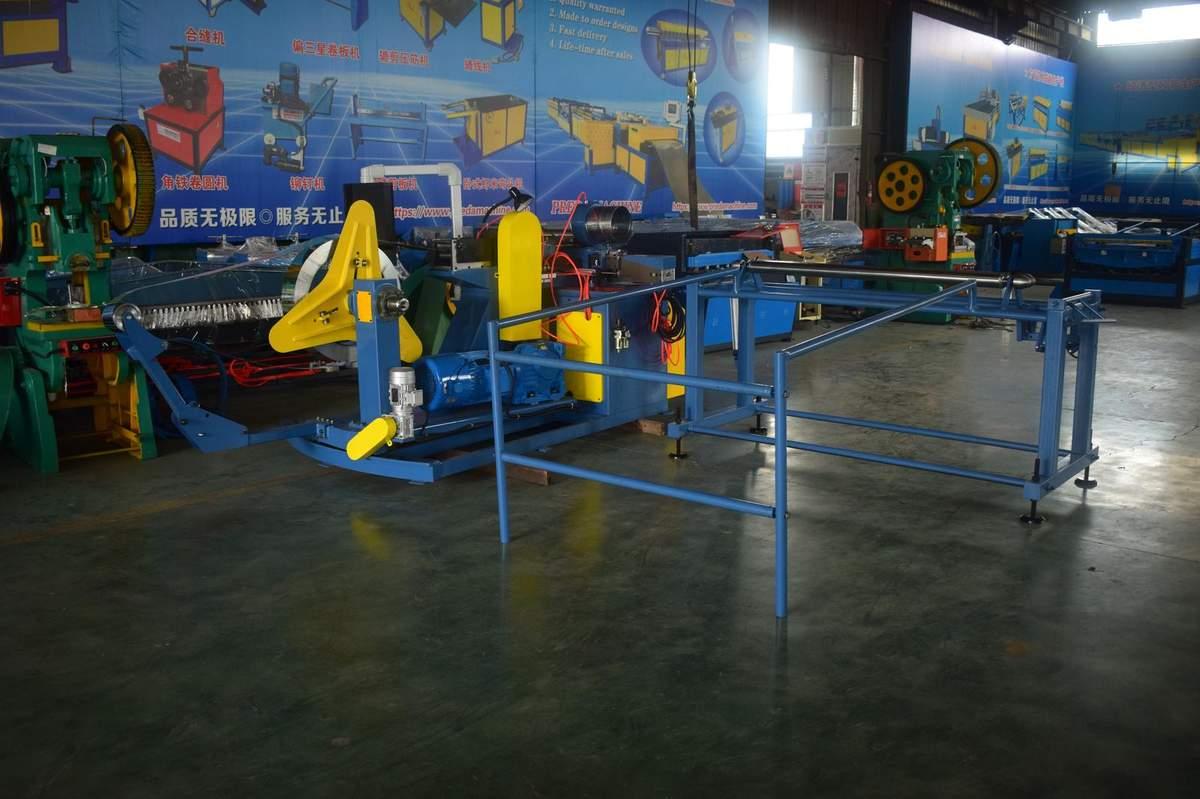
Mechanical roller cutting separates the material with hardened rollers or a shear that act across the tube wall, the same way strip is cut at the end of a blank. On the PD-1600, roller cutting is attached as standard. The cut edge is a clean mechanical separation without heat-affected zone, and the method works through the machine's standard gauge band without a gas or arc setup in the cutting station. Maintenance centres on roller and shear condition rather than consumables such as plasma electrodes and nozzles.
Mechanical cutting's limits follow the material itself. The shear has to punch or roll through the wall thickness the tubeformer forms, so thicker gauge or higher-strength material can exceed what the mechanical edge handles comfortably. Diameter range ties back to the mould system: the PD-1600 fixed-mould head produces 100-1600 mm from 137 mm strip in 0.4-1.2 mm, at a working speed of 1-38 m/min, with a 1200 kg coiler for continuous production.
Plasma Cutting Station
Plasma cutting uses an arc through a nozzle to sever the tube wall, offered on the PD-1600 as the PD1600-PLASMA configuration for thicker material or where on-the-fly cutting without stopping the tube is required. The arc handles thicker and tougher gauge than a mechanical shear can comfortably pass through, and the station can be arranged to track the advancing tube so the run does not pause at each section length. That suits long runs and large diameters where stopping the tube for every cut would eat into output.
Plasma introduces its own maintenance and edge considerations: electrode and nozzle consumables, arc calibration, and a heat-affected zone along the cut edge that needs awareness on galvanized or thinner material. The edge may show slight dross or a thermal mark compared with a mechanical shear, which matters for duct that will be gasketed, joined with a spiral collar or finished for a visible run. The plasma option is a configuration chosen against the shop's gauge and diameter mix, not a default upgrade over a shear.
How the Two Cutoff Methods Compare
The comparison below frames each method by how it separates the wall, what material it suits, whether the run must stop, and where its maintenance sits. Gauge and diameter figures come from the Preda product pages; general edge and setup behaviour is described qualitatively rather than rated against unverified numbers.
| Dimension | Roller shear / mechanical cut | Plasma cut |
|---|---|---|
| Separation principle | Hardened rollers or shear act through the wall | Arc through a nozzle severs the tube wall |
| Standard on | Attached standard on the PD-1600 | Optional PD1600-PLASMA configuration |
| Gauge fit | Suited to the standard commercial gauge band | Chosen for thicker or tougher gauge where a shear struggles |
| On-the-fly capability | Depends on station arrangement; stop-and-cut common on basic builds | Can track the advancing tube without stopping the run |
| Cut edge | Clean mechanical separation, no heat-affected zone | Thermal edge with possible dross or HAZ needing review |
| Consumables / upkeep | Roller and shear condition, no arc consumables | Electrode and nozzle replacement, arc calibration |
| Best match | Standard commercial spiral, galvanized strip, typical diameters | Heavier gauge, large diameter, long runs needing continuous cut |
PD-1600 vs PD-2000: Forming Range and Cutoff Context
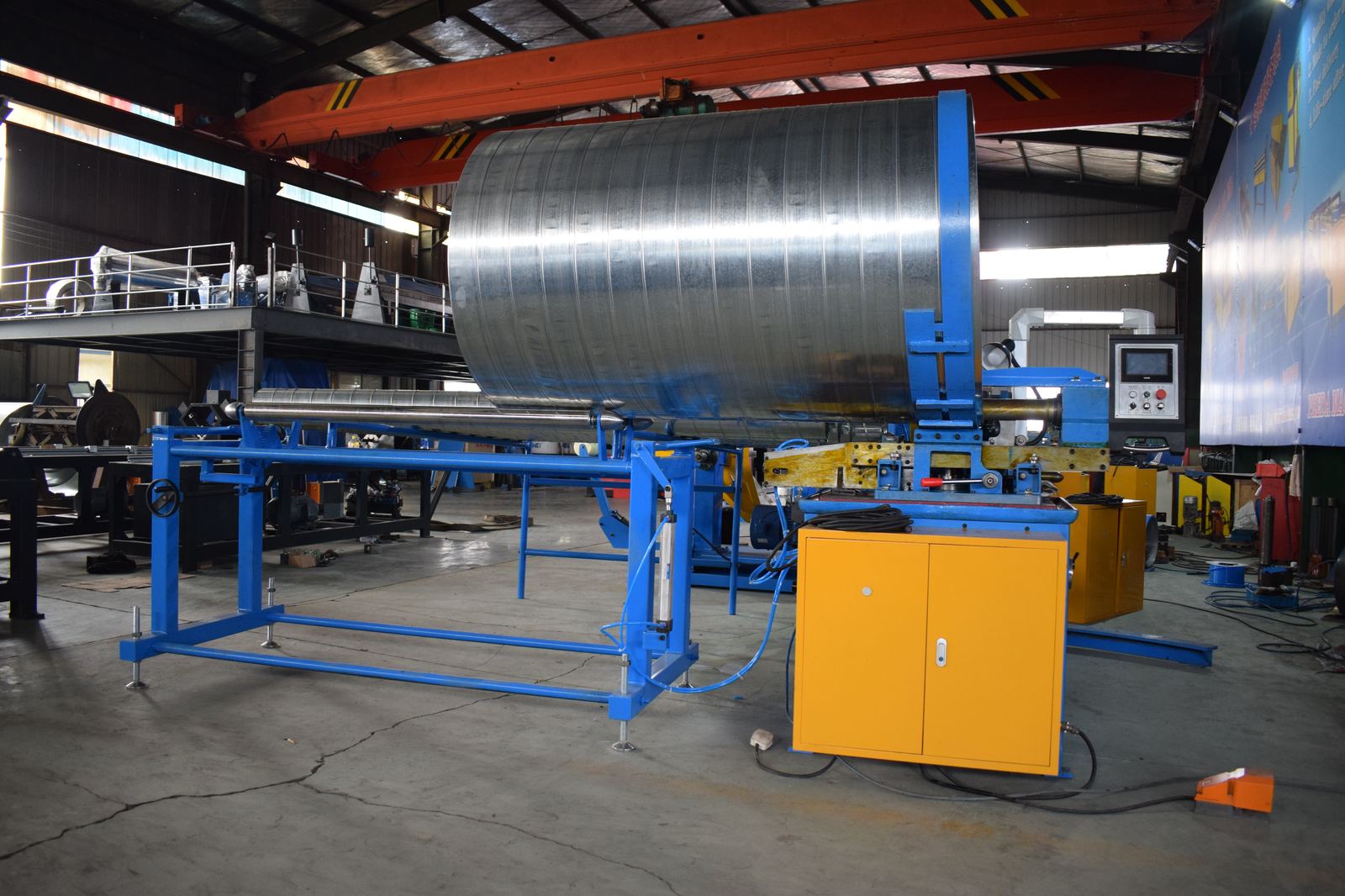
The tubeformer model sets the diameter and gauge the cutoff method serves. The PD-1600 is the fixed-mould mid-range workhorse; the PD-2000 is the heavy-duty machine for large diameter and heavier gauge, with a reinforced frame and heavy-duty components. A flying shear or slitter on the heavy-duty line cuts the continuous tube to programmed length without stopping production, suited to metro stations, parking garages and underground facilities that need large-diameter ductwork.
| Specification | PD-1600 | PD-2000 Heavy Duty |
|---|---|---|
| Diameter range | 100-1600 mm | Up to 2000 mm |
| Material thickness | 0.4-1.2 mm | 0.5-1.5 mm |
| Working speed | 1-38 m/min | 1-30 m/min |
| Motor power | 11+1 kW | 15 kW |
| Mould system | Fixed mould, consistent seam geometry | Heavy-duty mould system for large diameters |
| Cutoff | Roller cutting standard, plasma optional | Flying shear / slitter to programmed length without stopping |
| Coiler / weight | 1200 kg coiler capacity, 2000 kg machine | Reinforced frame for industrial large-diameter runs |
Choosing a Cutoff Method From the Order Mix
- Read the gauge band first. Most jobs in 0.4-1.2 mm galvanized strip fit mechanical cutting; recurring 0.5-1.5 mm or tougher material points toward plasma or a heavy-duty flying shear.
- Map diameter mix to machine range. A shop mostly on 100-600 mm does not need the PD-2000; regular 1200-2000 mm large duct justifies the heavy-duty model.
- Check whether the run can stop between lengths. Short sections and manual handling tolerate a stop-and-cut setup; long continuous runs reward an on-the-fly station.
- Look at the downstream joint. Gasketed spiral joints or visible runs favour a clean mechanical edge; industrial hidden large duct can accept a thermal edge where thickness matters more.
- Plan consumables and maintenance. A shear asks for roller condition checks; plasma adds electrode and nozzle supply plus arc calibration to the maintenance list.
Common Cutoff Choices That Cause Rework
- Taking plasma as the default for every size. Thinner commercial spiral is often better served by a clean mechanical edge, without consumable cost.
- Undersizing the machine for diameter. A cutoff method cannot rescue a head that cannot form the large diameter or the heavier gauge on the list.
- Ignoring edge finish for visible duct. A thermal edge on a gasketed or exposed run may need dressing before the joint seats.
- Assuming speed alone selects the method. The 1-38 and 1-30 m/min speed ranges describe forming travel; cutoff choice follows gauge, diameter and run pattern.
- Leaving consumables out of the budget. Plasma electrodes and nozzles are recurring items that should be costed alongside the machine.
What Cutoff Method Does Not Decide
The cutoff station finishes a section that the forming head has already produced. Consistent seam geometry, roundness and strip tension come from the mould system, rollers and setup; the cutoff only divides that formed tube at the right length. A strong shear or plasma station cannot fix a misaligned forming head, a worn roller or strip that feeds off-tension.
It also does not program itself. The operator still sets the diameter and length program, checks the first section against the drawing, and watches edge and length on the following cuts. Selecting the right method makes that first-check work easier; it does not replace the setter's judgment on each run.
List your gauge and diameter mix before asking about a cutoff
Collect the diameters, thicknesses and typical section lengths your projects call for over the last few months. If most jobs sit in 100-1600 mm and 0.4-1.2 mm, the PD-1600 with standard roller cutting is the starting point; recurring large diameter to 2000 mm or heavier 0.5-1.5 mm points to the PD-2000 heavy-duty build. Mark any jobs where the run cannot stop between lengths, and that decides whether an on-the-fly station is needed.
Preda Care Service Promise
Every Preda Machine ships CE certified with a two-year warranty, backed by technical support, spare parts shipping and a global agent network. A support engineer can review your diameter list, gauge band and run pattern against the PD-1600 roller or plasma configuration and the PD-2000 heavy-duty flying shear setup, and advise on the cutoff method that matches your duct mix.
Compare the Spiral Machine for Your Diameter Range
Share your round duct diameters, material thicknesses and whether runs need continuous on-the-fly cutting, and we will match the tubeformer model and cutoff configuration to that mix.
Compare Spiral Duct Machines →Frequently Asked Questions
Which cutoff is standard on the PD-1600?
Roller cutting is attached as standard on the PD-1600. Plasma cutting is the optional PD1600-PLASMA configuration, specified for thicker material or on-the-fly cutting without stopping the tube.
What diameter and gauge does the PD-1600 cover?
The fixed-mould PD-1600 produces 100-1600 mm diameter from 137 mm strip in 0.4-1.2 mm, at 1-38 m/min, with a 1200 kg coiler.
When does the PD-2000 heavy duty make sense?
For regular large diameter to 2000 mm and 0.5-1.5 mm material on industrial or large commercial jobs. A shop mostly on small to medium round duct does not need the heavy-duty frame.
Does plasma cut faster than a shear?
Cutoff speed depends on station arrangement and on-the-fly tracking, not the arc itself. The listed forming speeds are 1-38 m/min on the PD-1600 and 1-30 m/min on the PD-2000; choose the method against gauge, edge finish and run pattern.