This guide covers everything you need to know about HVAC Duct Factory Setup: Complete Equipment Guide (2026). Key takeaways: detailed specifications, cost comparisons, pros and cons, maintenance requirements, and expert recommendations from Preda Machine — a leading HVAC duct machinery manufacturer since 2008, serving 60+ countries.
In This Guide
- Planning Your Duct Factory
- Space Requirements and Layout
- Core Equipment List
- Rectangular Duct Production Line
- Spiral Duct Production Line
- Fittings and Accessories Equipment
- Labor and Staffing Plan
- Investment Budget Breakdown
- Production Flow Optimization
- Staffing Plan by Production Capacity
- First-Year Milestones
Planning Your Duct Factory
Before buying any equipment, you need to answer three fundamental questions that will determine every other decision:
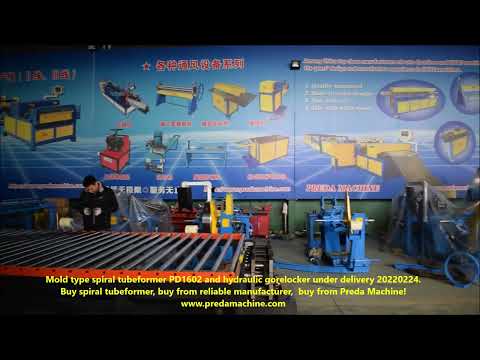
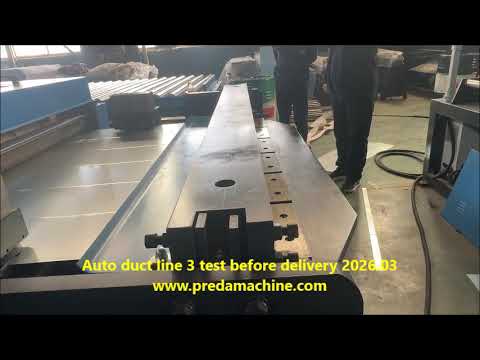
🎬 Watch Related Product Videos
See our machines running in real factory tests

- What is your target monthly output? This determines machine size and number of shifts
- What is your product mix? Rectangular vs spiral vs fittings ratio
- What is your budget? Equipment, facility, and working capital
A typical mid-size HVAC duct factory produces 30,000-50,000 m² of duct per year, employs 8-15 people, and requires 500-1,000 m² of floor space.
Start with the Market
Research your local market before buying equipment. If your area has mostly residential and small commercial projects, a smaller setup with a spiral machine and basic rectangular equipment may be sufficient. If you target large commercial and industrial projects, you need an auto duct line 5 and heavy-duty spiral machine.
Space Requirements and Layout
| Factory Size | Output Capacity | Equipment | Staff |
|---|---|---|---|
| 200-300 m² | 5,000-10,000 m²/year | Basic: spiral + lockformer + shear + folder | 3-5 |
| 500-800 m² | 20,000-40,000 m²/year | Medium: auto line 3 + spiral + fittings | 6-10 |
| 1,000-1,500 m² | 50,000-100,000 m²/year | Full: auto line 5 + spiral + plasma + fittings | 10-18 |
| 2,000+ m² | 100,000+ m²/year | Multiple lines + automation | 20+ |
Layout Principles
- Coil storage at one end — near loading dock, with overhead crane access
- Production lines in the middle — arranged in U-shape or straight-line flow
- Finished goods at the other end — near shipping dock
- Minimum 3-meter aisles — for forklift and material movement
- 3-phase power distribution — every machine needs its own circuit
- Compressed air lines — run overhead to avoid trip hazards
Core Equipment List
Every HVAC duct factory needs equipment in these categories:
| Category | Equipment | Purpose | Essential? |
|---|---|---|---|
| Rectangular | Auto Duct Line 5 | Full automatic rectangular duct production | Yes (for volume) |
| Rectangular | Pittsburgh Lockformer | Form Pittsburgh seam | Yes |
| Rectangular | TDF Flange Former | Form TDF flanges on duct ends | Yes |
| Spiral | Spiral Tubeformer PD1600 | Produce round spiral duct | Yes |
| Cutting | Shearing Machine | Cut sheet to size | Yes |
| Cutting | CNC Plasma Cutter | Cut fittings and custom shapes | Recommended |
| Folding | Folding Machine | Fold duct edges and seams | Yes |
| Assembly | Seam Locker | Close Pittsburgh seams | Yes |
| Flange | Corner Making Machine | Produce TDF/TDC corners | Recommended |
| Fittings | Gorelocker | Form spiral duct elbows | Recommended |
Rectangular Duct Production Line
Rectangular duct typically represents 60-70% of total production volume. The most efficient setup is an Auto Duct Line 5, which produces finished U-shaped duct sections from coil in one pass.
Rectangular Production Flow
- Coil loading — 5-8 ton galvanized coil loaded onto decoiler
- Leveling + beading — material flattened and stiffened
- Punching + notching — holes and notches cut automatically
- Shearing — cut to exact length
- Pittsburgh lock forming — seam rolled on one edge
- TDF flange forming — flange rolled on both ends
- Folding — folded into U-shape
- Assembly — close seam, add corners, install hardware
An Auto Duct Line 5 with one operator produces 1,000-2,500 m² per 8-hour shift.
Spiral Duct Production Line
Spiral duct represents 20-30% of production. The PD1600 spiral tubeformer handles 80-1600mm diameter and produces up to 25 m/min.
Spiral Production Flow
- Strip loading — galvanized strip (137mm wide standard) loaded
- Forming — helically wound and seamed continuously
- Cut-to-length — plasma or saw cut to specified length
- End finishing — beading, flanging, or coupling installation
- Fittings — elbows, reducers, tees made with gorelocker and plasma cutter
Fittings and Accessories Equipment
Fittings (elbows, tees, reducers, transitions) are the most labor-intensive part of duct production. Having the right equipment dramatically reduces fitting time:
- CNC Plasma Cutter — cuts flat patterns for any fitting shape in minutes
- Gorelocker — forms spiral duct elbows in 5-10 minutes
- Beading Machine — adds stiffening beads to large duct
- Corner Making Machine — produces TDF/TDC corners in-house
Labor and Staffing Plan
| Position | Count | Responsibilities | Skill Level |
|---|---|---|---|
| Factory Manager | 1 | Production scheduling, quality, customer liaison | Experienced |
| Auto Line Operator | 1-2 | Run auto duct line, input dimensions | Trainable (1-2 weeks) |
| Spiral Machine Operator | 1 | Run spiral tubeformer, change diameters | Trainable (1 week) |
| Fittings Fabricator | 2-3 | Plasma cutting, hand forming, assembly | Skilled (3-6 months) |
| Assembly Workers | 2-4 | Seam closing, flange installation, hardware | Entry level |
| Maintenance Tech | 0-1 | Machine maintenance, repairs | Skilled (or outsourced) |
Investment Budget Breakdown
| Item | Basic Setup | Standard Setup | Full Setup |
|---|---|---|---|
| Auto Duct Line | $18,000 (Line 3) | $45,000 (Line 5) | $55,000 (Line 5 U-shape) |
| Spiral Tubeformer | $10,000 (PD1200) | $18,000 (PD1600) | $25,000 (PD1600 + plasma) |
| Pittsburgh Lockformer | $3,500 | $5,000 | $5,000 |
| TDF Flange Former | $4,000 | $6,000 | $6,000 |
| Shear + Folder | $6,000 | $8,000 | $10,000 |
| Plasma Cutter | — | $8,000 | $12,000 |
| Seam Locker + Corners | $3,000 | $5,000 | $6,000 |
| Gorelocker | — | $5,000 | $7,000 |
| Tooling + Consumables | $2,000 | $4,000 | $6,000 |
| Equipment Total | $46,500 | $104,000 | $132,000 |
| Facility (deposit + reno) | $10,000 | $25,000 | $40,000 |
| Working Capital (3 months) | $20,000 | $40,000 | $60,000 |
| Total Investment | $76,500 | $169,000 | $232,000 |
Production Flow Optimization
The most profitable duct factories minimize material handling. Every time a worker moves a duct section, it costs money. Arrange equipment so material flows in one direction:
Coil Storage → Auto Line → Assembly Area → Finished Goods → Shipping
Place the spiral line parallel to the auto line so both can share coil storage and crane access. Keep the plasma cutter and fitting bench near the assembly area so fittings can be produced as needed without disrupting main line production.
Frequently Asked Questions
Preda Care: After-Sales That Never Expires
When you buy from Preda Machine, you get lifetime technical support. Our global agent network provides local service in 40+ countries. Free spare parts shipping, remote PLC diagnostics, video call troubleshooting, and on-site installation available.
- 24-hour response time
- Free spare parts shipping
- Remote PLC program support
- Global agent network
- Video call troubleshooting
- On-site installation
Staffing Plan by Production Capacity
Labour is the largest controllable cost in a duct factory, and the ratio of direct to indirect staff changes sharply with scale.
| Annual output | Direct operators | Indirect / support | Total | m² per person per year |
|---|---|---|---|---|
| 20,000 m² | 6 – 8 | 2 | 8 – 10 | 2,000 – 2,500 |
| 50,000 m² | 12 – 16 | 4 | 16 – 20 | 2,500 – 3,100 |
| 100,000 m² | 20 – 26 | 6 – 8 | 26 – 34 | 2,900 – 3,800 |
| 200,000 m² | 32 – 40 | 10 – 12 | 42 – 52 | 3,800 – 4,800 |
The jump in productivity between 20,000 and 200,000 m² is almost entirely automation, not harder work. Below about 30,000 m² per year, semi-automatic machines with skilled operators are more flexible and usually more profitable than a full line.
First-Year Milestones
| Month | Focus | Deliverable | Risk if skipped |
|---|---|---|---|
| 1 – 2 | Premises, utilities, machine selection | Signed equipment list with delivery dates | Equipment arrives before power is ready |
| 3 – 4 | Installation and commissioning | Every machine running a test part | Faults found in production, not commissioning |
| 5 – 6 | Operator training, standard work | Written setup sheets per machine | Quality depends on who is on shift |
| 7 – 9 | First production orders, quality system | Dimensional checks and leakage tests documented | Rework discovered on site |
| 10 – 12 | Capacity ramp, second shift planning | Utilisation above 70% | Overstaffed relative to orders |
Have Questions About Your Project?
Tell us your duct specifications, daily volume, and workshop size — our engineers recommend the perfect equipment within 24 hours.
Get Free ConsultationContinue Reading: Related Guides
Go deeper on this topic, then compare the machines that do the work.
HVAC Duct Fabrication Shop Setup
Equipment list and floor layout for a rectangular and round duct workshop.
Read the guide → SetupSheet Metal Shop Layout Guide
Workflow optimisation that cuts material handling distance and unblocks production bottlenecks.
Read the guide → PricingHVAC Duct Machine Cost: 2026 Price Guide
Realistic price bands for every machine category, plus financing and total-cost-of-ownership maths.
Read the guide → BusinessHVAC Duct Cleaning Equipment Guide
Tools, methods and business case for adding duct cleaning as a separate revenue line.
Read the guide →Machines covered in this topic
Compare specifications, gauge range and output for the machines discussed above.
Flexible Spiral Duct Making Machine PD-1200
Φ80–1200 mm, 0.4–1.2 mm gauge, flexible mould head
View specs → MachineStraight Auto Duct Line 5 AML-5
Full straight-type automatic rectangular duct line
View specs → MachineTDF Flange Former T-12
Single-head TDF flange forming machine
View specs → MachinePittsburgh Machine SA-15HB
Pittsburgh lock forming up to 1.2 mm
View specs →