An automatic duct line arrives as one connected forming system, and the day it starts depends on how the floor, the access route and the utilities were prepared before delivery. This guide covers the installation side of a rectangular auto duct line: what the footprint and clearances have to leave, how the machine is leveled and aligned, what the coil car and feed system need around it, and how commissioning moves from receiving inspection to the first finished panel. The figures used below are the verified AML-3 and AML-6 specifications; unlisted power, output or space figures are not claimed.
Before the Line Arrives: Route, Floor and Layout
The installation starts well before the crate arrives. The line has to travel from the delivery point to its final position through doors, columns, floor drains and pit edges that may not accept a machine of its size. The receiving area should be checked for clear route width, floor capacity along the path, and enough room to unload and move the sections into place. Once the line is in position, the straight-line and U-shape arrangements spread those dimensions differently: the straight line runs its stations along one long axis, while the U-shape returns panels around the end and needs the inner radius kept clear for panel flow.
The floor itself should be level, firm and free of soft spots under the main frame. The line is leveled on its mounting points so the forming rolls close evenly along the panel width; an uneven bed transfers to the panel as wave or uneven edge. Around the frame, the layout has to leave room for coil handling, finished panel removal, operator access to controls and maintenance reach to the drives and guides.
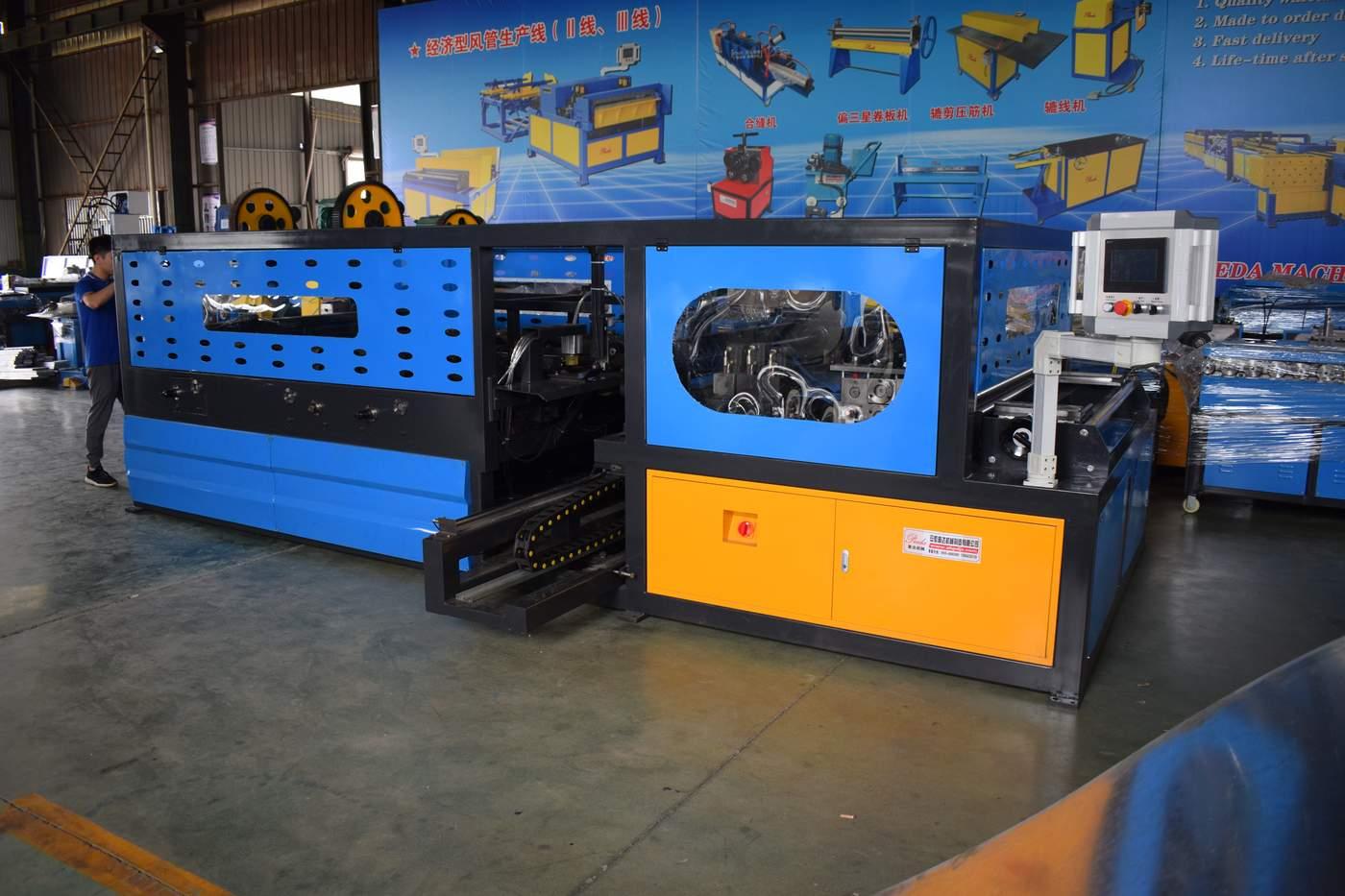
Installation and Commissioning Checklist
The checklist follows the order the machine is actually put to work: confirm what arrived, level and align the frame, set up coil and discharge access, connect power and controls, then run commissioning panels through the stations. Each stage gates the next, because a frame that is not level or a coil car that cannot reach its loading position will not be fixed by adjusting the controls later.
| Stage | What is checked | Preparation focus | Acceptance point |
|---|---|---|---|
| Receiving inspection | Sections, drives, controls and coil equipment match the order | Unpack against the packing list; protect rolls and guides from damage | All stations and components present; controls and screens intact |
| Floor and leveling | Frame sits on a firm, level bed; mounting points adjusted | Clear route in; floor flat under main frame; foundation ready | Frame level along length and width; no wobble on mounting points |
| Coil car access | Coil loading path to the feed, with room to load and retract | Coil car lane kept clear; coil stand aligned to the feeder | Coil cart moves under the line smoothly; loading and unloading free |
| Side and overhead clearance | Operator zone, discharge rack and maintenance reach open | Leave clearance along both sides and above the frame; no obstruction | Panel exits to the rack; controls reachable; service access open |
| Power and controls | Supply capacity matches the rated installed power; PLC wired | Supply sized to the machine; control screen and comms checked | System powers up, PLC and touchscreen respond, no fault codes |
| Commissioning panels | First panels run through decoil, form, notch and discharge | Run trial strip at the active gauge; check panel flatness and edge | Finished panel flat, width and gauge correct; stations feed in sequence |
Footprint, Weight and Installed Power by Line Class
The space and supply planning for an auto duct line follows its size class. The AML-3 is the three-station automatic line built around a dual-station coil car, PLC with Mitsubishi touchscreen, CE certification and two-year warranty. The AML-6 is the higher-speed computer-controlled line with four electric coil stands and four material carriages, handling 5-7 ton coils, also CE certified with a two-year warranty. The table below lists the verified dimensions, weights and power for the 1300 mm model and the rating differences for the 1500/1600 mm models.
| Specification | AML-3 Auto Duct Line | AML-6 Super Auto Duct Line |
|---|---|---|
| Panel width | 1300 / 1500 / 1600 mm | 1300 / 1500 / 1600 mm |
| Material thickness | 0.45-1.5 mm | 0.45-1.5 mm |
| Working speed | 12 m/min | 16 m/min |
| Control system | PLC with Mitsubishi touchscreen | Computer control system |
| Coil handling | Dual-station coil car | Four electric stands, four carriages, 5-7 t per coil |
| 1300 model dimensions | 6500 x 2200 x 1600 mm | 5600 x 3600 x 1650 mm |
| 1300 model power | 18 kW | 13 kW |
| 1300 model weight | 5-6 t | 4 t |
| 1500 / 1600 model power | 20 kW | 15 kW |
| 1500 / 1600 model weight | 5-6 t | 4.5-5 t |
| Certification / warranty | CE certified, two-year warranty | CE certified, two-year warranty |
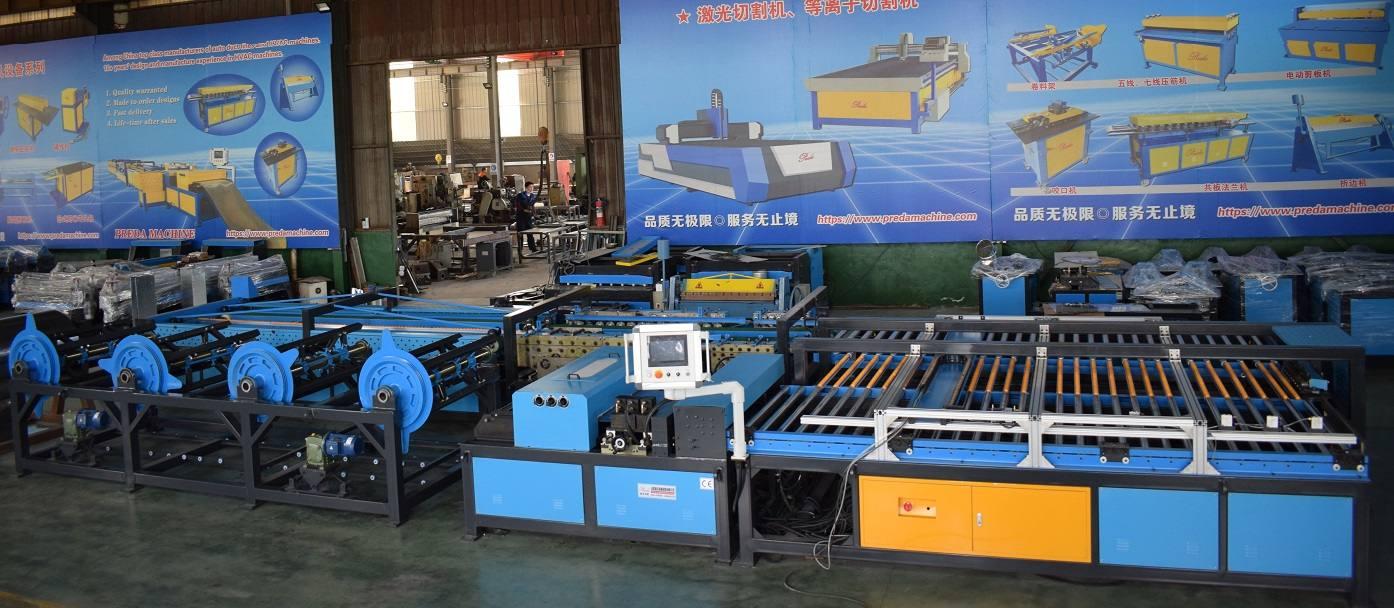
Layout Choice Affects the Clearance You Reserve
The straight-line and U-shape arrangements are covered in detail in the layout comparison guide, but installation planning cannot skip the spatial consequence. A straight line reserves one long clear axis for the full length of the machine and its discharge; a U-shape folds the panel flow back around the end, which shortens the wall-to-wall run but adds clearance around the inner curve where panels return. Decide the arrangement before marking the floor, because the coil car lane, control position and discharge rack are placed differently in each. The machine itself does not force the shape; the shop's column spacing, door position and panel flow do.
Coil access deserves its own planning step. The AML-3 dual-station coil car moves a loaded coil into the feeder and retracts; the AML-6 four-stand setup holds multiple coils so the line can switch gauge without a single-car swap. In either case the lane in front of the feeder stays clear for the coil cart, and the coil storage sits close enough to the line that loading does not cross the panel flow.
Commissioning: From Trial Strip to First Panel
Commissioning does not stop when the line powers up. A trial strip at the active gauge runs through decoiling, forming, notching and discharge so each station can be checked in sequence. The first finished panel is measured for width, checked for flatness along its length, and inspected along the edges and corners. Panel wave, edge curl or off-width on that first panel traces back to frame level, roll alignment, feeder tension or guide position; these are corrected during commissioning rather than left for production tuning.
Operator training on the control is part of the handover. The touchscreen or computer control sets panel dimensions, gauge and run parameters; the operator should be able to call up a panel specification, start the run and read a fault condition before the shop takes the line over. Spare-part access and the warranty terms are confirmed at handover, so routine service has a clear reference.
Common Installation Pitfalls
- Route too narrow: the machine sections cannot reach the final position; measure doors, columns and aisle width before delivery.
- Soft or uneven floor: frame cannot be leveled; panels show wave or uneven edge that roll adjustments will not remove.
- Coil lane blocked: the coil car cannot load or retract, and changeover slows to a manual swap; keep the feeder lane clear in the layout.
- Power supply undersized: the line trips under load; match the supply to the rated installed power for the model width.
- Discharge rack too close: panels cannot exit the last station; reserve open space at the discharge end of the line.
Measure the floor and the route before ordering
Record the machine length, width and the coil-car and discharge clearances for your chosen arrangement, then walk the delivery route and mark any low door, column or step. A machine that cannot reach its foundation costs more to fix than the space that was planned around it.
Frequently Asked Questions
What floor preparation does an auto duct line need?
A firm, level floor under the main frame so the machine can be leveled on its mounting points, plus a clear route for delivery and coil handling. Soft spots or an uneven bed should be corrected before the frame is set down.
How much space around the line should be left?
Reserve operator access to the controls, maintenance reach to the drives and guides, the coil-car lane to the feeder, and open space at the discharge end for finished panels. The straight line and U-shape distribute this space differently, so plan the arrangement first.
Which line class fits a standard shop?
The AML-3 dual-station coil car line suits standard rectangular duct work in 0.45-1.5 mm at 1300/1500/1600 mm widths; the AML-6 higher-speed four-stand line suits shops running heavier coil loads and faster panel output. Supply, floor and coil handling are planned to the class chosen.
What confirms commissioning is complete?
The line powers up with no fault codes, the control responds, and trial panels run through every station with correct width, flat edges and clean discharge. Operator handling of a panel specification and basic fault reading completes the handover.
Preda Care Service Promise
Every Preda Machine ships CE certified with a two-year warranty, backed by 24/7 technical support, free spare parts shipping, remote PLC programming assistance and a global agent network. A support engineer can review your shop dimensions, coil weights and panel widths against the AML-3 or AML-6 and help plan the foundation, clearance and commissioning sequence.
Plan Your Line Around Your Shop Layout
Share your floor dimensions, panel widths, gauges and coil weights, and we will recommend the AML-3 or AML-6 configuration and the layout, clearance and power planning needed to commission it smoothly.
Compare Auto Duct Lines →