Spiral tubeformers spend their lives moving between one round diameter and the next as orders change. A diameter change is not a single dial adjustment: the strip feeding into the forming head, the die or center head that wraps the strip into a circle, the overlap seam and the cutoff all have to match the new finished tube size together. This guide walks through what changes at each station when the diameter moves, how the two Preda tubeformer classes handle the change, and what the first finished section must confirm before the batch runs. Machine figures come from the verified PD-1600 and PD-2000 specifications; no unlisted output or cycle figure is claimed.
What Moves When the Finished Diameter Changes
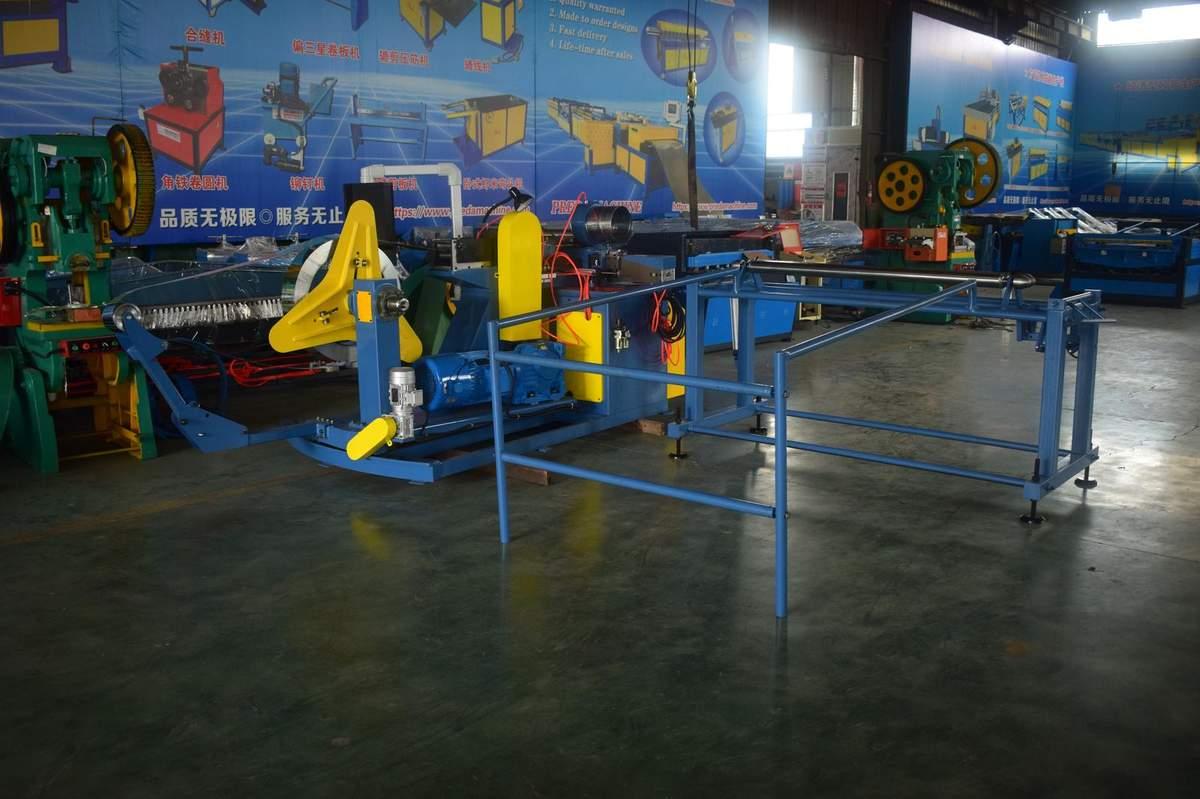
The spiral duct machine feeds a narrow strip off the coil, guides it through the forming head, wraps it helically around the die or center head, and seams the overlapping edges as the tube advances. When the finished diameter changes, three things have to agree: the strip dimension feeding the head, the forming die set for the new circle, and the cutoff that separates sections to length. If only one of these is reset, the tube either does not hold the round shape, the seam overlaps unevenly, or sections cut to the wrong geometry.
The strip itself follows the diameter and gauge combination. The wider the tube and the heavier the strip, the more strip the wrap consumes per revolution; the coil queue at the coiler should be matched to the gauge before the change, so the run does not stop for a coil swap partway through. The forming head and die set then shape that strip to the target circle, and the cutoff separates the finished tube once it reaches the section length.
Station-by-Station Setup for a New Diameter
The stations are checked in feed order, because each one sets a condition the next relies on. The coiler and feed straighten and advance the strip; the guide lines the strip into the forming head; the die or center head wraps it to the new circle; the seam rollers close the overlap; the cutoff separates the finished tube. A mismatch introduced upstream carries into the finished section, so the checklist follows the strip instead of inspecting the tube alone.
| Station | What the diameter change affects | Setup focus | First-section check |
|---|---|---|---|
| Coiler / feed | Strip gauge and width must match the new diameter combination | Queued coil matches active gauge; leading edge threads cleanly | Strip advances straight, no side wander, correct strip width |
| Strip guide | Guide position keeps the strip entering the head square | Guide aligned to the forming head centerline | Strip enters without skew; overlap sits along one edge |
| Forming head / die | Die or center head set to the target finished diameter | Die set for the new circle; seam rollers positioned for the overlap | Round profile holds along the section, no ovality or flat spots |
| Seam rollers | Closure follows the wrapped overlap for the new size | Roller pressure matched to gauge and overlap | Seam runs even along the length, no lifted or split overlap |
| Cutoff / discharge | Cutoff separates sections to the ordered length | Cutoff set for the new tube diameter and length | Clean cut square to the tube; section exits to the discharge rack |
Fixed-Die vs Heavy-Duty Die-Type Construction
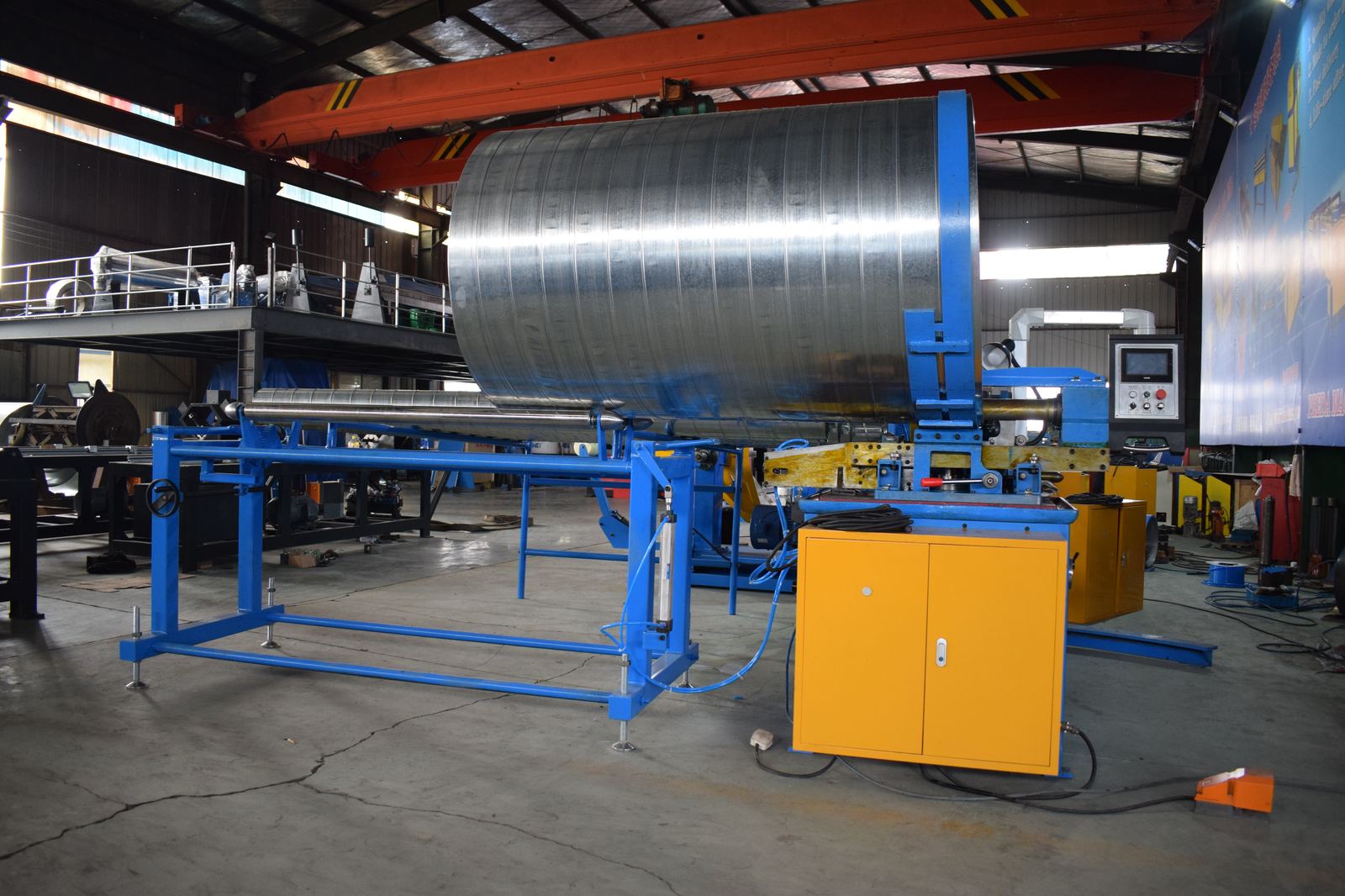
Tubeformers differ in how the forming head handles diameter changes. The PD-1600 uses a fixed die construction suited to the 100-1600 mm working band, pairing a coiler, forming head and roller cutoff as the standard arrangement, with plasma cutoff available as an option. The PD-2000 is the heavy-duty die-type machine for diameters up to 2000 mm, working heavier gauge strip, and carries a flying shear and slitter in its setup. The structural difference changes how a diameter change is carried out on each class, rather than changing the station sequence the operator checks.
| Specification | PD-1600 Spiral Tubeformer | PD-2000 Heavy-Duty Tubeformer |
|---|---|---|
| Finished diameter | 100-1600 mm | Up to 2000 mm |
| Material thickness | 0.4-1.2 mm | 0.5-1.5 mm |
| Working speed | 1-38 m/min | 1-30 m/min |
| Strip width | 137 mm feeding strip | Slitter / flying shear arrangement |
| Forming structure | Fixed die | Heavy-duty die type |
| Coiler | 1200 kg coiler | Heavy-duty coil handling |
| Cutoff | Roller cutoff standard; plasma cutoff optional | Flying shear with slitter |
| Installed power | 11 + 1 kW | 15 kW |
| Weight / footprint | 2000 kg; 5500 x 1800 x 1600 mm | Heavy-duty die-type frame |
| Certification / warranty | CE certified, two-year warranty | CE certified, two-year warranty |
Gauge, Strip and the First Finished Section
Diameter and gauge move together on the setup sheet. A large diameter in thin strip needs the head held to a true circle without over-supporting the light sheet; a smaller diameter in heavier gauge needs enough forming pressure to wrap the stiff strip and close the overlap. The first finished section is measured across its diameter at both ends, checked for roundness, and inspected along the seam before the rest of the batch runs. Any ovality, uneven overlap or ragged cut on that first section traces back to the feed, guide, die or cutoff station that caused it.
Existing shop knowledge still guides the call. The recorded setting from the last run of the same diameter and gauge gives the starting point, but the operator reads the first tube, confirms the round profile and seam, and watches the run for drift as the coil feeds. Machine settings repeat the conditions; the operator judges whether the finished section matches the drawing.
Common Changeover Problems and Their Source
- Tube comes out oval or flat-sided: die or center head not set to the target circle, or strip guide feeding off-line; check the forming head before cutting more sections.
- Uneven or lifted overlap: seam rollers not matched to the gauge or overlap angle; inspect the seam along the first section.
- Wrong strip width on the new diameter: coil or strip queue not matched to the new combination; verify before threading the head.
- Cut angle not square: cutoff alignment drifted with the new diameter; check the cut face on the first finished tube.
- Seam splits on heavier gauge: forming pressure or gauge range beyond the machine class; confirm the strip sits inside the rated band.
Record one setup per recurring diameter and gauge
Note the die setting, guide position, strip width, gauge and cutoff position for each diameter you repeat often. On the next changeover, start from that record and confirm it against the first finished section instead of rebuilding the setup from memory.
Frequently Asked Questions
Does changing diameter require a different machine?
No within a machine's rated band. The PD-1600 covers 100-1600 mm and the PD-2000 up to 2000 mm; diameters outside a machine's band call for the next class, not an adjustment to the existing die.
Which tubeformer suits frequent diameter changes?
Both classes reset per diameter at the feed, head and cutoff. The PD-1600 fixed-die machine covers the standard 100-1600 mm band in 0.4-1.2 mm; the PD-2000 heavy-duty die-type handles larger diameters and 0.5-1.5 mm strip. The choice follows diameter range, gauge and coil weight rather than changeover convenience alone.
What does the first finished section have to show?
Round profile at both ends, correct diameter, even overlap seam along the length, and a square cutoff. Problems on that section trace back to feed, guide, die or cutoff.
Is plasma cutoff standard on the spiral line?
On the PD-1600 the roller cutoff is standard and the plasma cutoff is the optional configuration; the PD-2000 carries a flying shear with slitter. Cutoff choice is matched to section length, gauge and production rhythm.
Preda Care Service Promise
Every Preda Machine ships CE certified with a two-year warranty, backed by 24/7 technical support, free spare parts shipping, remote PLC programming assistance and a global agent network. A support engineer can review your diameter range, gauges and strip mix against the PD-1600 or PD-2000 and walk through the changeover setup and first-section check.
Match the Tubeformer to Your Diameter and Gauge Range
Send the round duct diameters, gauges and section lengths you produce most often, and we will map them to the PD-1600 or PD-2000, including the die, strip and cutoff setup that keeps sections consistent across diameter changes.
Compare Spiral Tubeformers →