A spiral tubeformer only runs as steadily as the coil feeding it. The coiler and payoff station hold the strip roll, rotate it off the feed, and keep the strip advancing into the forming head without slack, over-tension or side wander. When the coil weight, strip width or gauge does not match what the feed station can hold and pull, the forming head compensates unevenly: the seam overlaps drift, the tube runs oval, or the strip stalls mid-section. This guide covers how coil weight and strip condition are matched to the coiler, what the payoff and feed check before a run, and how a coil swap is carried out without stopping the forming rhythm. Machine figures come from the verified PD-1600 and PD-2000 specifications; no unlisted coil-weight, output or cycle figure is claimed.
What the Coiler and Payoff Have to Handle
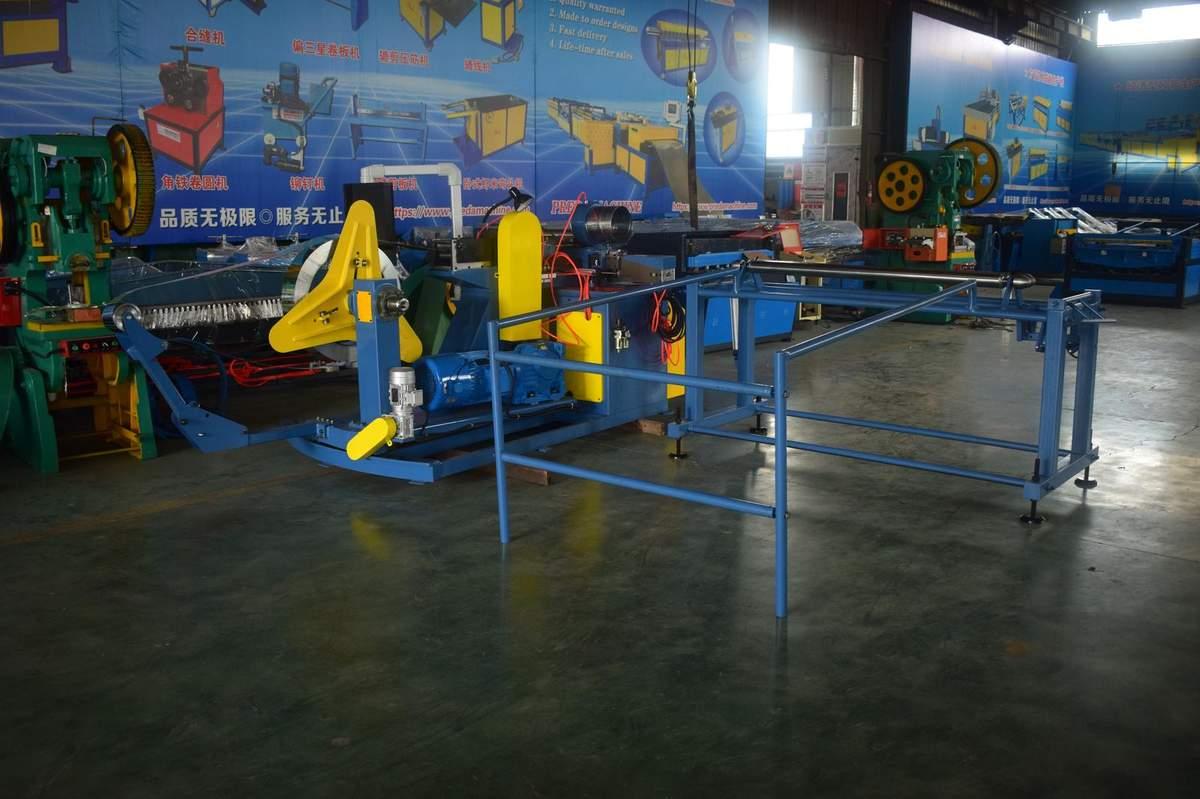
Before the strip reaches the forming head, the feed side of the spiral line does three jobs: it supports the roll, pays the strip off at a steady rate as the tube advances, and keeps the strip aligned so it enters the guide square. The coiler capacity sets how heavy a roll can be loaded without the feed struggling; the payoff tension has to stay even so a light strip is not stretched and a heavy gauge is not dragged loose. Strip width and gauge then determine how much material leaves the roll per revolution and how the queue at the feed should be matched before the new run starts.
Coil condition matters as much as weight. A roll that sits off-center on the mandrel feeds strip to one side; a crooked or damaged leading edge threads unevenly into the guide; loose wrap on the roll can telescope and bind as it pays out. These are feed-side conditions that show up downstream as oval tube or an uneven overlap seam, so the coil is checked before the forming head rather than blamed on the rollers later.
Coil and Feed Checks Before the Run
The checklist follows the strip from the roll toward the forming head. Each condition set at the feed side carries into the tube, so the checks are made in feed order: coil load on the mandrel, strip leading edge, guide alignment, feed tension and the queued next roll. A mismatch introduced here cannot be corrected by the forming head or the cutoff.
| Feed-side point | What the coil combination affects | Setup focus | First-section check |
|---|---|---|---|
| Coiler load / mandrel | Whether the roll weight sits within coiler capacity and stays centered | Roll seated on the mandrel; clamp secured; no off-center weight | Strip feeds straight off the roll, no side pull or telescope |
| Strip leading edge | How the strip threads into the guide and head | Leading edge straight and clean; no bent or torn end | Edge threads cleanly into the guide without skew |
| Strip guide | Alignment keeping the strip entering the head square | Guide lined to the forming head centerline | Strip enters without wandering; overlap sits along one edge |
| Feed tension / payoff | Even strip advance without slack or over-stretch | Payoff matched to gauge and run speed; tension steady through the roll | Strip advances smoothly; no slack loops or tight pulls |
| Queued next coil | Whether the next roll matches active gauge and width | Replacement roll matched to the current combination before the run reaches it | Swap can be made without changing strip mid-batch |
PD-1600 and PD-2000 Feed Capacity Compared
The two Preda tubeformer classes differ in diameter band, gauge and coil handling, which changes how feed capacity is planned rather than changing the feed checklist. The PD-1600 is the fixed-mould mid-range machine built around a 1200 kg coiler, feeding 137 mm strip through the forming head for 100-1600 mm duct in 0.4-1.2 mm gauge. The PD-2000 is the heavy-duty mould-type machine for diameters up to 2000 mm in 0.5-1.5 mm strip, paired with a flying shear and slitter. The table lists the verified feed and machine figures; coil weight beyond the rated coiler capacity should not be loaded onto the feed.
| Specification | PD-1600 Spiral Tubeformer | PD-2000 Heavy-Duty Tubeformer |
|---|---|---|
| Finished diameter | 100-1600 mm | Up to 2000 mm |
| Material thickness | 0.4-1.2 mm | 0.5-1.5 mm |
| Working speed | 1-38 m/min | 1-30 m/min |
| Feeding strip | 137 mm strip | Slitter / flying shear arrangement |
| Coiler capacity | 1200 kg coiler | Heavy-duty coil handling |
| Forming structure | Fixed mould / fixed die | Heavy-duty mould type |
| Cutoff | Roller cutoff standard; plasma cutoff optional | Flying shear with slitter |
| Installed power | 11 + 1 kW | 15 kW |
| Weight / footprint | 2000 kg; 5500 x 1800 x 1600 mm | Heavy-duty mould-type frame |
| Certification / warranty | CE certified, two-year warranty | CE certified, two-year warranty |
Coil Weight, Gauge and Strip Width Move Together
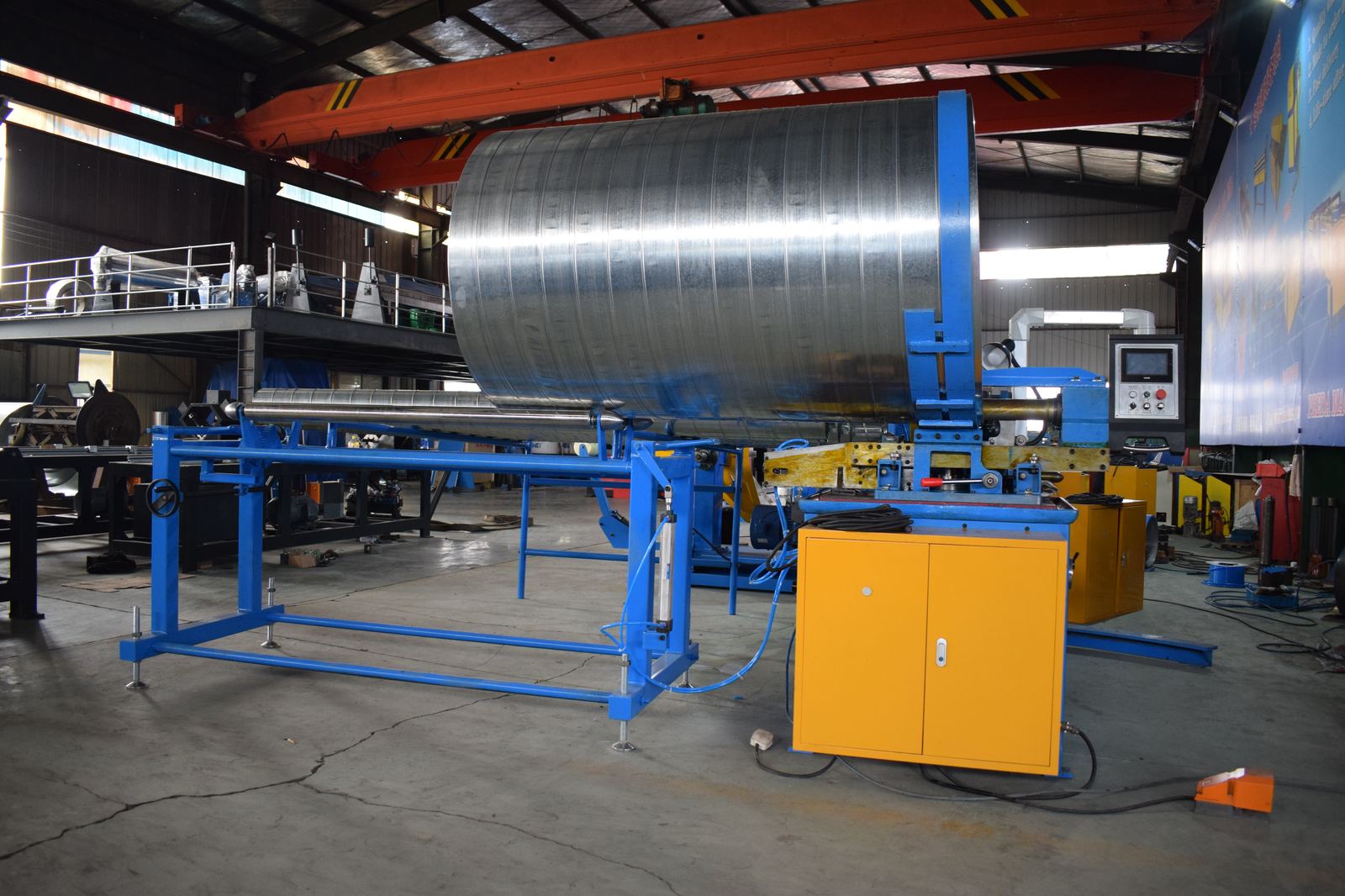
Coiler matching is not a single weight number. A wide strip in heavier gauge builds a heavier roll per meter of width and pulls more firmly through the feed; a narrow, light strip pays out easily but can tangle if the payoff tension drops. Before loading, the roll gauge, width and remaining weight are checked against the rated coiler capacity and the strip the forming head expects. The strip width follows the diameter and gauge combination, and the coiler should hold the roll steady through the whole wrap so the feed does not fight a slipping or overloaded payoff.
When the active coil runs low, the swap is planned before the strip reaches the last wrap. On the PD-1600 the next roll is queued beside the feed; if it carries a different gauge or width it should be matched to the next job before it is threaded, so the line does not stop for a program and feed change partway through. The replacement roll is seated on the mandrel, centered, and its leading edge checked before it takes over the feed.
Common Feed-Side Problems and Their Source
- Strip wanders side to side: roll off-center on the mandrel or guide misaligned; recenter the coil and check guide alignment before running more tube.
- Slack loops ahead of the head: payoff tension too light for the gauge; adjust the feed so the strip advances without looping.
- Stretched or narrow-looking strip: payoff tension too high, especially on light gauge; release tension so the strip feeds at the run speed.
- Coiler strains or can't turn the roll: coil weight or gauge beyond the feed capacity; load a roll within the rated coiler band.
- Seam overlap drifts along the run: feed alignment or strip guide shifted; check the guide and coil centerline on the first section.
Record one feed setup per recurring coil combination
Note the gauge, strip width, coil weight and payoff setting for each diameter you repeat often. On the next coil swap, start from that record and confirm the first section rather than resetting tension and guide position from memory.
Frequently Asked Questions
How is coiler capacity matched to the coil?
Load only rolls within the rated coiler weight for the machine class, and match the strip gauge and width to the forming band. The PD-1600 carries a 1200 kg coiler for 137 mm strip in 0.4-1.2 mm; heavier coil handling and thicker strip belong to the PD-2000 class.
Does a heavier gauge coil need a different coiler setting?
Heavier strip pulls more firmly and builds a heavier roll; the payoff tension and feed are set to that gauge so the strip neither slips loose nor over-stretches. Confirm the gauge sits inside the machine's rated band before threading.
What does the first finished section confirm about the feed?
A straight strip feed, true round profile at both ends, even overlap along the length and a clean cutoff. Ovality, wandering seam or slack on that first section traces back to coil centering, guide alignment or payoff tension.
Can one coiler handle both galvanized and stainless strip?
The PD-1600 works galvanized, stainless and aluminum within its 0.4-1.2 mm band; feed tension and guide are checked per material and gauge. Outside the rated band the next machine class, not a feed adjustment, is the answer.
Preda Care Service Promise
Every Preda Machine ships CE certified with a two-year warranty, backed by 24/7 technical support, free spare parts shipping, remote PLC programming assistance and a global agent network. A support engineer can review your coil weights, strip widths and gauges against the PD-1600 or PD-2000 and confirm the coiler and feed setup for your diameter range.
Match the Coiler and Tubeformer to Your Coil and Diameter Range
Send the round duct diameters, gauges, strip widths and typical coil weights you run, and we will map them to the PD-1600 or PD-2000, including the coiler capacity and feed setup that keeps sections consistent coil after coil.
Compare Spiral Tubeformers →