This guide covers everything you need to know about Auto Duct Line 3 vs Line 5: Complete Comparison (2026). Key takeaways: detailed specifications, cost comparisons, pros and cons, maintenance requirements, and expert recommendations from Preda Machine — a leading HVAC duct machinery manufacturer since 2008, serving 60+ countries.
In This Guide
What Is an Auto Duct Line?
An auto duct line is a fully integrated production system that takes a coil of galvanized steel and produces finished rectangular duct sections in one continuous process. The line handles uncoiling, leveling, beading, punching, notching, shearing, Pittsburgh lock forming, TDF flange forming, and folding — all automatically.
🎬 Watch Related Product Videos
See our machines running in real factory tests
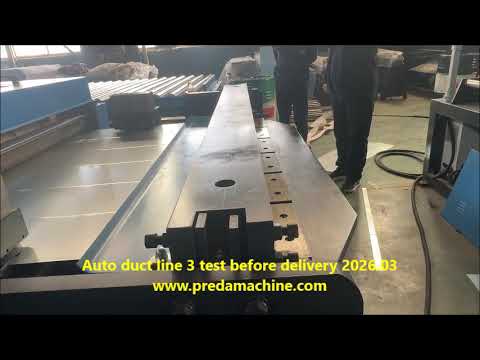
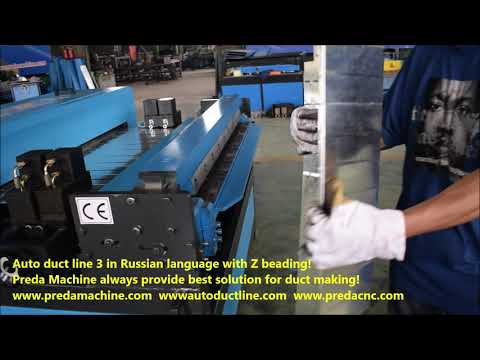
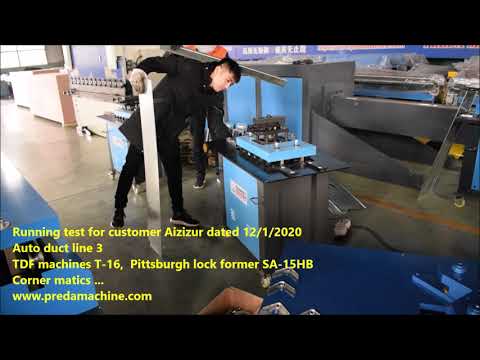
The numbers (Line 2, 3, 4, 5) refer to how many processing stations are integrated into the line. More stations = more automation = less manual labor = higher output.
Line 3 vs Line 5: Full Comparison
| Specification | Auto Duct Line 3 | Auto Duct Line 5 |
|---|---|---|
| Automation Level | Semi-automatic | Fully automatic |
| Daily Output (8h shift) | 600-1,000 m² | 1,000-2,500 m² |
| Workers Required | 2-3 | 1-2 |
| Pittsburgh Lock | Separate machine needed | Integrated |
| TDF Flange Forming | Separate machine needed | Integrated |
| Final Folding | Manual or separate folder | Integrated (U-shape output) |
| Line Length | 8-12 meters | 18-25 meters |
| Coil Weight | Up to 5 tons | Up to 8 tons (dual decoiler) |
| Material Thickness | 0.5-1.2mm | 0.5-1.5mm |
| Price Range (USD) | $15,000-$25,000 | $35,000-$60,000 |
| Best For | Small shops, startups | Medium-large factories |
Auto Duct Line 3: Detailed Review
The Auto Duct Line 3 is the entry-level automated solution. It integrates three core processes: coil handling (uncoil + level + bead), cutting (punch + notch + shear), and basic folding. Pittsburgh lock forming and TDF flange forming are handled at separate stations.
Advantages of Line 3
- Lower upfront cost — typically 40-50% less than Line 5
- Compact footprint — fits in workshops under 200 m²
- Flexible — can handle irregular shapes and small batches
- Easier maintenance — fewer integrated components means simpler servicing
- Good for startups — lower risk investment while building customer base
Limitations of Line 3
- Requires 2-3 workers (one at line, one at lockformer, one at flange machine)
- Output caps around 1,000 m²/day — hard to scale up for big projects
- Multiple material handling steps increase labor and error risk
View Auto Duct Line 3 specifications →
Auto Duct Line 5: Detailed Review
The Auto Duct Line 5 is the industry standard for high-volume rectangular duct production. It integrates all five processes into one continuous line: coil handling → cutting → Pittsburgh lock → TDF flange → final folding. The output is a finished U-shaped duct section ready for assembly.
Advantages of Line 5
- 2-3x higher output — up to 2,500 m²/day with one operator
- Labor savings — 1-2 workers vs 3-4 for Line 3 + separate machines
- Consistent quality — all processes controlled by one PLC, no handoff errors
- Dual decoiler — 8-ton coils mean fewer coil changes, less downtime
- U-shape output — ducts come out pre-folded, just close and seal
Limitations of Line 5
- Higher upfront investment ($35K-$60K)
- Requires 200+ m² floor space (18-25m line length)
- Less flexible for very small or custom pieces
View Auto Duct Line 5 specifications → | View U-Shape Line 5 →
ROI and Payback Analysis
Let's compare the real economics for a shop producing 15,000 m² of duct per year:
| Factor | Line 3 Setup | Line 5 Setup |
|---|---|---|
| Equipment Cost | $25,000 (line + lockformer + flange) | $50,000 |
| Labor (3 workers × $25/hr × 2000h) | $150,000/year | $75,000/year (1.5 workers) |
| Annual Output | 15,000 m² (at capacity) | 30,000 m² (headroom) |
| Labor Cost per m² | $10.00 | $2.50 |
| Annual Labor Savings | — | $75,000/year |
| Payback Period | — | ~8 months |
Key Insight
At 15,000 m²/year, Line 5 pays for itself in labor savings alone within 8 months. If your shop is currently running 2+ shifts with Line 3, upgrading to Line 5 is almost always the right financial decision.
How to Choose
- Daily output under 600 m²? Line 3 is sufficient and more affordable
- Daily output 600-1,200 m²? Line 3 works but you need 3 workers; Line 5 saves labor
- Daily output over 1,200 m²? Line 5 is necessary — Line 3 cannot keep up
- Workshop under 150 m²? Line 3 fits; Line 5 may not
- Planning to grow in 2-3 years? Buy Line 5 now — upgrading later costs more in downtime
Factory Layout Tips
Line 5 requires careful planning. The line itself is 18-25 meters long, plus you need space for:
- Coil storage (2-3 spare coils at the entry)
- Output conveyor or run-out table (3-5 meters)
- Operator walkway along the full length
- Overhead crane for coil loading (minimum 5-ton capacity)
Many shops arrange Line 5 parallel to a spiral tubeformer so both can share coil storage and crane access.
Frequently Asked Questions
Preda Care: After-Sales That Never Expires
When you buy from Preda Machine, you get lifetime technical support. Our global agent network provides local service in 40+ countries. Free spare parts shipping, remote PLC diagnostics, video call troubleshooting, and on-site installation available.
- 24-hour response time
- Free spare parts shipping
- Remote PLC program support
- Global agent network
- Video call troubleshooting
- On-site installation
What Each Coil Station Actually Does
The difference between Line 3 and Line 5 is not simply "more stations". Each station removes a manual handling step, and the value of that depends on your job mix.
| Station | Line 3 | Line 5 | Time saved per part |
|---|---|---|---|
| Decoiling | Standard | Dual coil, auto load | 1 – 2 min per coil change |
| Levelling / straightening | Present | Present, higher capacity | — |
| Beading / cross-breaking | Optional | Standard, programmable | 3 – 5 min |
| Notching and punching | Notch only | Notch plus hole punch | 2 – 4 min |
| Pittsburgh lock forming | Present | Present | — |
| TDF / TDC flange forming | One flange type | Changeover in under 5 min | 4 – 8 min per changeover |
| Shearing and cutting | Guillotine | Servo shear, tighter tolerance | 1 – 2 min |
| Folding / closing | Manual assist | Automatic folder | 4 – 6 min |
The Folder Is the Real Difference
An automatic closing and folding station is what turns a line from "makes flat blanks" into "makes finished duct sections". If your volume justifies a line at all, it usually justifies the Line 5 — but only if your part mix is standard enough to keep the folder fed.
Labour Model: Who Operates Each Line
| Scenario | Operators, Line 3 | Operators, Line 5 | Output per shift | m² per labour hour |
|---|---|---|---|---|
| Straight duct only | 2 | 2 | 900 – 1,400 m² | 56 – 88 |
| Duct plus fittings | 3 | 2 – 3 | 600 – 1,000 m² | 25 – 42 |
| High mix, small batches | 3 – 4 | 3 | 350 – 600 m² | 12 – 20 |
| Repeat production, one size | 2 | 1 – 2 | 1,400 – 2,200 m² | 88 – 140 |
Note the collapse in productivity on high-mix work. An auto duct line is a repeat-production machine. If your shop is 80% bespoke fittings, a plasma table plus semi-automatic formers will out-produce it.
Have Questions About Your Project?
Tell us your duct specifications, daily volume, and workshop size — our engineers recommend the perfect equipment within 24 hours.
Get Free ConsultationContinue Reading: Related Guides
Go deeper on this topic, then compare the machines that do the work.
Auto Duct Line Buying Guide 2026
Line 2 through Line 5 compared on labour saved, floor space and payback period.
Read the guide → Buying GuideDuct Beading Machine Buying Guide 2026
CNC vs manual vs 5-groove beaders — bead spacing, gauge limits and when beading is required.
Read the guide → Buying GuideGorelocker Elbow Machine Guide 2026
Hydraulic vs electric gorelockers: cycle time, gauge range and which elbow sizes each handles.
Read the guide → Buying GuidePittsburgh Lockformer Buying Guide 2026
SA-15HB vs SA-12HB vs snaplock vs S&drive: which lock profile and machine fits your duct class.
Read the guide →Machines covered in this topic
Compare specifications, gauge range and output for the machines discussed above.
Straight Auto Duct Line 5 AML-5
Full straight-type automatic rectangular duct line
View specs → MachineFlexible Spiral Duct Making Machine PD-1200
Φ80–1200 mm, 0.4–1.2 mm gauge, flexible mould head
View specs → MachineTDF Flange Former T-12
Single-head TDF flange forming machine
View specs → MachinePittsburgh Machine SA-15HB
Pittsburgh lock forming up to 1.2 mm
View specs →